

Best vehicle window decal types for small business branding 2026
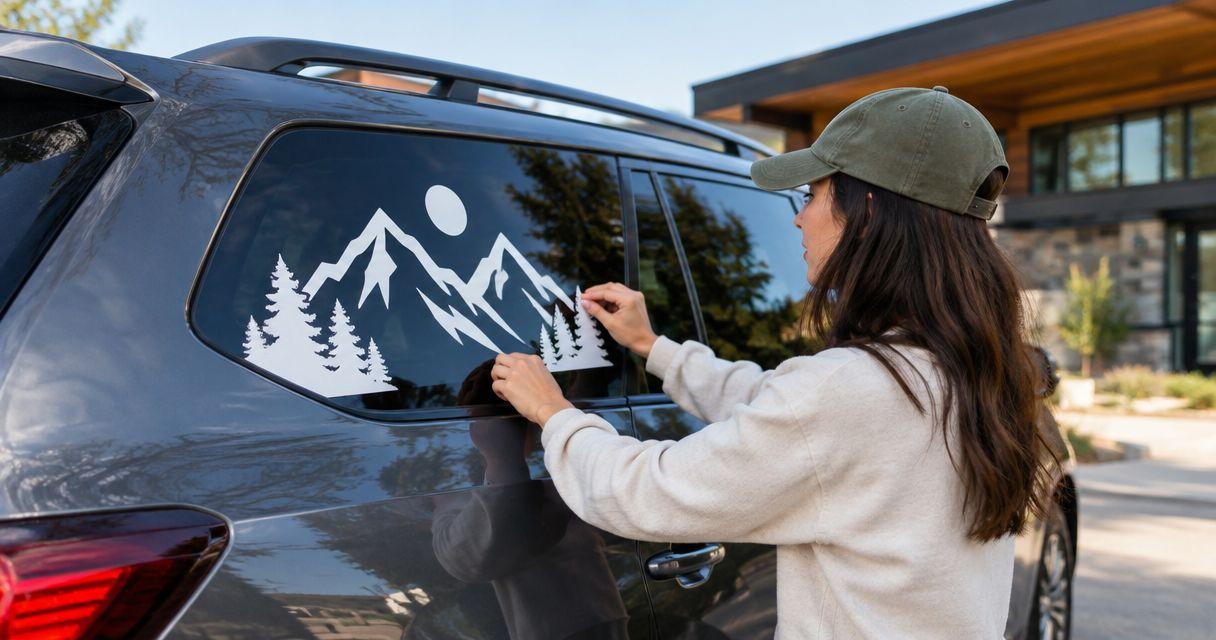
Best for simple lettering: cut vinyl. Best for full-color logos: opaque printed decals. Best for temporary campaigns: static cling. Choose custom car window decals in 2026 by artwork, mounting method and the glass area you can legally use—not by shape alone.
- Custom car window decals need a mounting decision before a design decision: exterior adhesive, interior-facing print or removable cling.
- Cut vinyl suits simple lettering; opaque printed decals suit full-color logos with a solid background.
- Perforated window film needs visibility checks; its holes do not guarantee safe sightlines.
- Vinylstatus serves businesses ordering custom stickers and decals; confirm vehicle-glass requirements before choosing a format.
Why this matters
A logo that works on packaging does not automatically work on vehicle glass. Dark interiors, reflections, defroster lines and moving windows change how the design reads and where you can place it.
Vinylstatus offers custom stickers and decals from your artwork. For vehicle branding, confirm the specific material, adhesive and mounting direction before ordering; the sticker's outline alone does not establish suitability for automotive glass.
The best vehicle window decal is the smallest clear message that fits a legal, usable section of glass. Your business name and one contact method usually deserve priority over a list of services squeezed into the same space.
What makes the best custom car window decals?
Use these criteria for your 2026 order before comparing decal types:
- Readability: Your business name and contact method must remain distinct against the actual window background.
- Mounting direction: Exterior application and inside-glass, outward-facing application require different print and adhesive arrangements.
- Glass compatibility: Confirm suitability for the intended surface, including any tint film, heating elements or moving-window seals.
- Visibility and placement: Keep required sightlines, mirrors, cameras, lights and legally restricted areas clear.
- Artwork fit: Match fine lettering, gradients, white areas and intricate outlines to a material that can reproduce them.
- Removal needs: Tell the printer whether the message is temporary, seasonal or intended to stay in place.
Vehicle window decal types at a glance
These are format comparisons, not a statement that every option is sold by Vinylstatus. Ask about the exact construction rather than ordering by the category name alone.
| Decal type | Best for | Standout feature | Key limitation |
|---|---|---|---|
| Cut vinyl lettering | Simple business names and contact details | Separate letters without a surrounding printed panel | Intricate artwork makes cutting and application harder |
| Opaque printed decal | Full-color logos | Solid background separates artwork from dark glass | Blocks the view through its footprint |
| Clear printed decal | Artwork needing a transparent surround | Glass remains visible around printed elements | Color appearance depends on opacity and white ink |
| Perforated window film | Larger rear-window graphics | Perforations leave openings within the graphic | Visibility changes with lighting and conditions |
| Static-cling graphic | Temporary promotions on suitable glass | Nonadhesive attachment | Surface and mounting requirements need careful confirmation |
1. Cut vinyl: best for simple business lettering
Cut vinyl lettering leaves individual letters or shapes on the glass after application. It suits a business name, a short website address or a simple mark without gradients or photographic detail.
Best for: A service business that needs readable identification rather than a large illustrated advertisement.
Cut vinyl pros:
- No surrounding printed rectangle competes with your lettering.
- Simple artwork gives the message a clear visual hierarchy.
- Separate elements leave uncovered glass between letters.
Cut vinyl cons:
- Tiny text and thin strokes complicate cutting, handling and installation.
- Complex multicolor artwork can require more involved preparation and alignment.
Choose letter color against the vehicle's actual interior, not a white design canvas. Dark lettering against dark glass loses separation. Check the message with the doors shut and the vehicle in its normal parking conditions.
For a 2026 business rebrand, approve the contact details before producing lettering for multiple vehicles. Replacing one incorrect phone digit still means correcting physical graphics.
Verdict: Buy cut vinyl for simple lettering; skip it for photographs and gradients.
2. Opaque printed decals: best for full-color logos
An opaque printed decal places your artwork on a solid-backed shape. That background separates logo colors from the window and interior behind them.
Best for: Small businesses whose logos include multiple colors, gradients or a badge-style composition.
Opaque printed decal pros:
- A solid background makes the artwork less dependent on the view through the glass.
- Full-color artwork stays together as one graphic.
- A simple outer shape avoids applying individual letters separately.
Opaque printed decal cons:
- The entire footprint blocks the view through that section of glass.
- An oversized background can dominate a small window without improving the message.
A die-cut outline describes the shape, not the adhesive, finish or vehicle suitability. Ask separately about those properties. Also check whether small gaps around the logo are part of the printed background or actual cutouts.
Vinylstatus custom decals are an option for small businesses supplying their own artwork; vehicle-window suitability still requires confirmation for the selected product.
Verdict: Buy an opaque printed decal when logo reproduction matters more than transparency within its footprint.
3. Clear printed decals: best for a transparent surround
Clear printed decals leave transparent material around the artwork. The printed portions need their own opacity decisions, especially when a logo contains white or pale colors.
Best for: A compact logo whose surrounding glass should remain visually open.
Clear printed decal pros:
- Transparent areas avoid a solid background panel.
- Printed artwork can include details beyond simple cut lettering.
- One piece keeps the elements in their intended positions.
Clear printed decal cons:
- Transparent inks can change appearance against dark glass and interiors.
- White artwork and opaque colors require confirmation of the printer's white-ink setup.
Do not approve a clear decal solely from an image shown on white. Request an explanation of which areas are transparent, which are printed and where white ink sits beneath the color.
Inside-glass mounting is a separate question. A standard clear decal does not automatically read correctly from outside when applied inside. Confirm the viewing side, adhesive side and print orientation together.
Verdict: Hold the order until transparency, white ink and mounting direction are explicit.
4. Perforated window film: best for larger rear graphics
Perforated window film combines a printed graphic with openings through the material. It is a specialized option for larger window graphics, not a substitute for checking visibility and local requirements.
Best for: A business considering substantial rear-window coverage and prepared to assess installation and sightlines.
Perforated window film pros:
- Supports a larger graphic across a window area.
- Openings provide a different viewing effect from solid opaque film.
- Offers an alternative to placing separate small graphics across the glass.
Perforated window film cons:
- Lighting, water and the viewing angle affect what you can see through it.
- Small lettering and fine details compete with the perforation pattern.
- Edges, window shape and installation requirements need particular attention.
Check rear visibility in daylight and darkness before treating the format as suitable. Ask the installer about the intended glass, edge treatment and any finishing requirements for the selected film.
For a 2026 fleet refresh, do not approve this format on a flat artwork proof alone. Placement and visibility are separate approval decisions.
Verdict: Hold until an installer confirms the material, placement and visibility requirements.
5. Static cling: best for temporary window messages
Static-cling graphics attach without a conventional adhesive. Use them only where the specific material is intended to work; a temporary window promotion has different requirements from an exterior graphic on a moving vehicle.
Best for: Short-term messages on suitable glass when easy removal matters more than permanent identification.
Static-cling pros:
- Avoids a conventional adhesive layer.
- Suits messages intended to come down after a campaign.
- Allows temporary branding without treating it as a permanent vehicle graphic.
Static-cling cons:
- Cleanliness, surface condition and mounting position affect attachment.
- Exterior use and repeated reuse must be confirmed rather than assumed.
Ask which side faces the glass and whether the design reads correctly from the intended viewing side. Do not assume that a cling intended for an indoor shop window is suitable for exterior vehicle use.
Verdict: Buy only for a confirmed temporary application; skip unverified exterior use.
Plan the message before ordering the quantity
A window decal should identify the business without requiring someone to study it. For a trade vehicle, prioritize the name and one contact method. For a delivery vehicle, make identification clear before adding promotional copy.
Real estate businesses face the same distinction between recognition and explanation: vehicle wraps for real estate agents address a larger branding area, while a window decal needs a shorter message that fits the available glass. Do not shrink a full wrap layout into a window graphic.
Build your 2026 quantity from actual placements. For an illustrative order, 4 vehicles with 2 approved placements each require 8 decals before you decide whether to add replacements. That is an ordering calculation, not a recommended minimum.
Separate artwork versions in the count. Driver-side and passenger-side layouts, different phone numbers or separate service areas can turn one planned order into several distinct files. Label each version before approving production.
Check size, mounting and the proof in order
Use this sequence before committing your artwork to print:
- Measure placement. Measure the usable glass area, excluding restricted areas, seals and obstructions.
- Make mockup. Place a paper version at actual size and inspect it from outside.
- Confirm mounting. Specify exterior application or inside-glass viewing, plus the exact intended surface.
- Check artwork. Verify contact details, cut lines, transparency and small lettering.
- Approve proof. Approve only after the physical placement and production details agree.
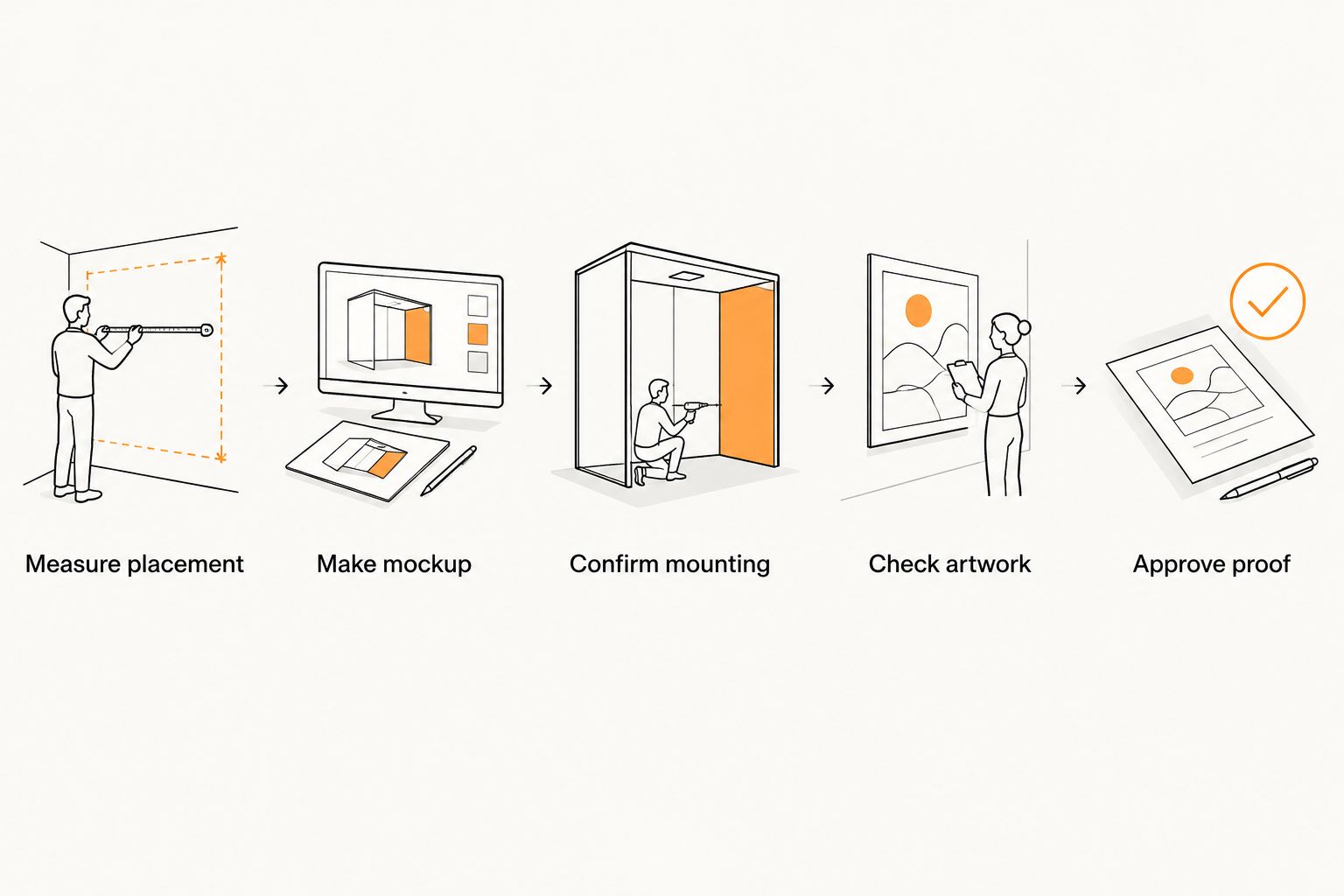
For a sizing example, a 10-inch-wide paper mockup centered within a 12-inch-wide usable area leaves 1 inch on each side. Those dimensions illustrate the layout calculation; they are not a legal clearance or product specification.
Check the paper mockup with the rear wiper at rest and through its sweep. On a moving side window, consider where the graphic travels when the glass lowers. Do not cover cameras, sensors or required markings.
Ask about proof review and liner construction for the exact product. A split-back liner concerns peeling the backing; transfer tape serves a different role when positioning separate cut letters. Neither term establishes vehicle compatibility.
Before scheduling a campaign, distinguish production after proof approval from shipping time. Confirm both for the selected order rather than treating a production estimate as an arrival date.
How the formats were ranked
The order follows buying questions: simple lettering, full-color artwork, transparent surrounds, larger coverage and temporary use. It is not a durability ranking or a claim that one supplier outperforms another.
For your 2026 comparison, eliminate formats that fail the mounting or visibility requirements first. Then choose the one that reproduces your message with the least unnecessary coverage.
Which vehicle window decal should you choose?
Choose cut vinyl for a simple business name and contact detail. Choose an opaque printed decal for a full-color logo. Move to clear film only when you need transparent surroundings and have confirmed the print construction.
Keep perforated film and static cling tied to their specific applications rather than treating them as interchangeable upgrades. Send your artwork, window placement and mounting requirements through the contact page before choosing a product that has not been confirmed for the job.
FAQ
What’s the best type of custom car window decal for a business logo?
An opaque printed decal suits a full-color business logo because its solid background separates the artwork from the glass. Cut vinyl suits simpler logos and lettering without gradients or photographic detail.
Can I put a window decal inside the car facing out?
Yes, when the decal is produced for inside-glass application and outward viewing. Confirm the adhesive side, print orientation and how the artwork will look through the glass and any tint.
Are clear car window decals invisible around the logo?
Clear decals have transparent material around the printed artwork, but the material and its edges can remain visible. Confirm white ink and opacity so the logo does not depend on a white background that will not exist on the vehicle.
Can I put a decal over window tint?
Confirm compatibility with the decal supplier and tint installer before applying a decal directly to tint film. Establish whether the intended placement is on exterior glass or on the interior film, because those are different surfaces.
Does perforated window film guarantee a clear view out?
No. Perforated film changes the view through the window, and lighting, water and viewing angle affect visibility. Check the intended installation against local requirements and actual driving conditions.
How many business vehicle decals should I order?
Count approved placements on each vehicle, then separate any artwork versions and decide whether replacements are necessary. Do not base the order on vehicle count alone when some vehicles need multiple graphics.
Should I approve the artwork before checking the window?
No. Check the placement with an actual-size paper mockup before approving the proof. A correct print file can still produce a decal that is too large, poorly positioned or hard to read on the vehicle.
One last thing
Photograph the paper mockup against the real window before ordering. Reflections and a dark interior can expose a contrast problem that a clean digital proof hides. Fix that problem in the artwork—not after the decals arrive.