

Best windshield banner styles for car dealership promotions 2026
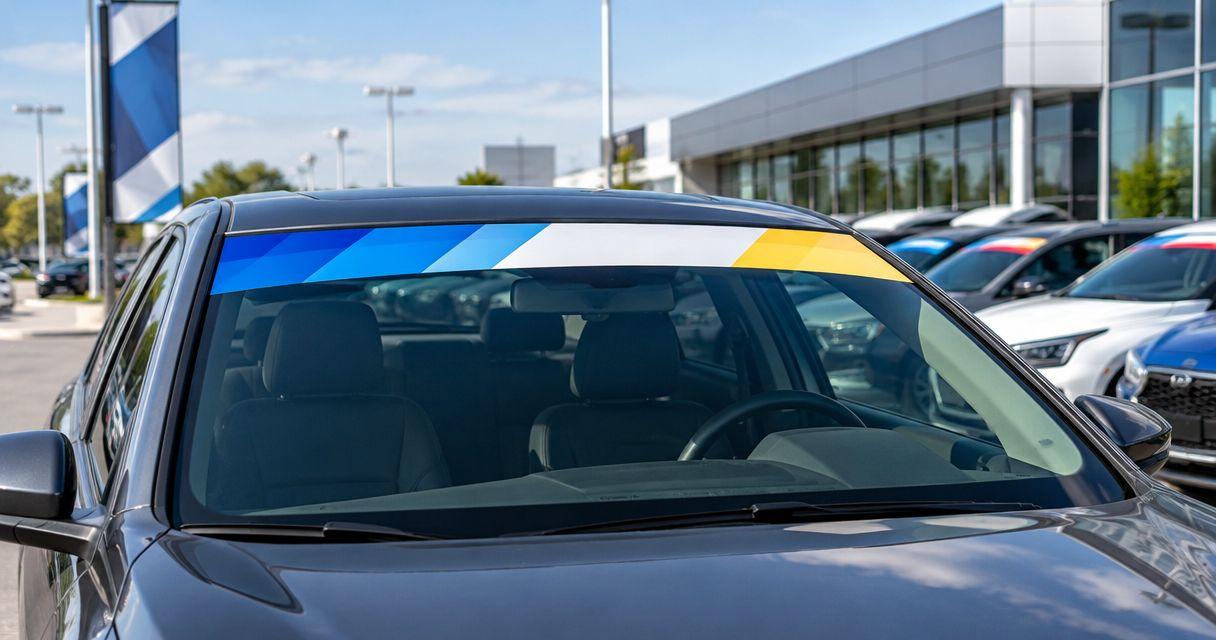
Best for dealership identity: a single-line wordmark. Best for inventory grouping: a category label. Best for a scheduled promotion: an event banner. Choose your custom windshield banner style in 2026 by the message buyers need to read, then confirm fit, visibility and application requirements before ordering.
- Choose a single-line wordmark custom windshield banner for dealership identity, not a crowded sales pitch.
- Use inventory labels for vehicle categories and event banners for dated promotions.
- Keep QR codes on parked displays and scan-test the final printed size.
- Vinyl Status offers custom decals; confirm windshield-specific material, sizing and application requirements before ordering.
Why this matters
A windshield banner gives you a limited space for one useful message. Adding a dealership name, vehicle category, event details and contact information to the same strip creates competing reading tasks.
Choose one job for each banner. A dealership identity banner should identify the seller. An inventory label should help visitors distinguish vehicle groups. An event banner should explain the promotion without becoming a miniature flyer.
Vinyl Status offers custom stickers and decals from your artwork. For a windshield application, confirm the exact material, adhesive, dimensions, installation surface and removal instructions before choosing a production format.
For a 2026 promotion, separate the display plan from the driving plan. Check applicable windshield-obstruction rules, and do not assume a promotional banner is suitable for road use because it fits the glass.
What makes the best custom windshield banner style?
Judge the layout against these criteria before choosing a shape or finish:
- Message priority: A reader should identify the main message without sorting through several equally prominent elements.
- Glass fit: The design must account for windshield curvature, trim, cameras, sensors and the intended installation position.
- Readable contrast: Compare the lettering against the actual glass and reflections, not only a white artwork background.
- Useful lifespan: Separate reusable dealership branding from dated event messages and changing inventory claims.
- Application workflow: Confirm installation, peeling and removal requirements before committing to a bulk order.
- Proof accuracy: Check spelling, dimensions, cut boundaries and any QR destination before approval.
For printed stickers, ask whether the selected format includes free online proofs, human artwork checks and split-back liners. Also confirm whether two-business-day production after proof approval and made-in-the-USA production apply to that exact product. Keep shipping time separate from production time.
Windshield banner styles at a glance for 2026
These are layout recommendations for different dealership tasks, not claims that one material or supplier outperforms another. Choose the row that matches your intended message.
| Style | Best for | Standout feature | Key limitation |
|---|---|---|---|
| Single-line wordmark | Dealership identity | One consistent dealership name | Does not explain a promotion |
| Inventory category label | Grouping vehicles | One category per banner | Requires accurate vehicle matching |
| Event message banner | Scheduled promotions | A clear event-specific message | Dated artwork needs replacement |
| Contact-detail banner | Direct follow-up | One phone number or short web address | Long details compete with readability |
| QR-led display banner | Parked vehicle information | A scannable route to relevant details | Requires close-range access and testing |
1. Single-line wordmark: best for dealership identity
A single-line wordmark puts your dealership name at the center of the design. It suits a consistent identity across a group of display vehicles without tying every banner to a particular promotion.
Use the actual dealership artwork rather than retyping a distinctive logo in a similar font. If the full logo includes a small tagline or detailed emblem, prepare a simplified version for the windshield layout and approve that version explicitly.
Single-line wordmark pros:
- Keeps the dealership name as the main reading task.
- Avoids dates and event details that need frequent changes.
- Supports consistent artwork across different display vehicles.
Single-line wordmark cons:
- Does not communicate a specific inventory category or event.
- A long dealership name leaves less room for large lettering.
Ordering advice: Measure each windshield type before standardizing the dimensions. A consistent design does not require an identical physical width on every vehicle.
Best for: Dealers who want a recognizable identity across their display inventory.
Verdict: Buy for dealership identification after checking fit; skip extra promotional copy.
2. Inventory category label: best for grouping vehicles
An inventory category label helps shoppers distinguish groups such as used vehicles, electric vehicles or commercial vans. Use a category only when it accurately describes the vehicle carrying the banner.
Keep the wording consistent with how your dealership organizes inventory. Do not use certification, inspection or warranty language unless the vehicle qualifies and the wording has been approved for that purpose.
Inventory category label pros:
- Gives the banner a clear wayfinding role.
- Separates inventory groups without requiring a detailed explanation.
- Lets staff use a consistent label for a defined category.
Inventory category label cons:
- Misapplied labels create inaccurate vehicle descriptions.
- Broad categories do not communicate individual vehicle features.
Ordering advice: Build the quantity from the eligible vehicles, not the entire lot. Keep different category designs separated in storage so staff do not apply the wrong label during vehicle preparation.
Best for: Dealerships that need visitors to distinguish inventory groups at a glance.
Verdict: Buy for accurate category identification; skip claims that need fine-print qualifications.
3. Event message banner: best for scheduled promotions
An event message banner supports a specific dealership promotion, open house or sales event. Give the event name priority and include dates only when readers need them to understand when the message applies.
For a 2026 event, check the year and every date in the proof. Avoid carrying a past event layout into a new order without reviewing all the text.
Event message banner pros:
- Connects the display directly to a scheduled promotion.
- Keeps temporary messaging separate from permanent dealership artwork.
- Gives staff a defined start and removal point.
Event message banner cons:
- Dated banners stop being useful when the event ends.
- Detailed promotional terms do not fit comfortably into a short strip.
Ordering advice: Count the vehicles that will display the message during the event. Plan removal alongside installation, and keep any required promotional disclosures in an appropriate, readable format rather than shrinking them to fit.
Best for: Dealers with a specific event and a defined display period.
Verdict: Buy for a scheduled promotion; skip dated artwork for an evergreen dealership order.
4. Contact-detail banner: best for direct follow-up
A contact-detail banner gives shoppers one way to reach the dealership after viewing a parked vehicle. Choose either a phone number or a short, recognizable web address as the main response detail.
Do not treat the banner as a business card. A street address, social handles, phone number and long web address all demand space that the main response detail needs.
Contact-detail banner pros:
- Gives visitors a direct next action.
- Works without requiring a phone camera to scan a code.
- Keeps the layout focused when you choose one contact method.
Contact-detail banner cons:
- Long addresses and small digits are difficult to read at a distance.
- Changed contact information makes existing artwork inaccurate.
Ordering advice: Have another staff member independently check every digit or character. Test the printed layout at the viewing distance you expect shoppers to use, not only on a monitor.
Best for: Parked displays where visitors need a simple follow-up route.
Verdict: Buy when one verified contact detail is enough; skip a crowded contact directory.
5. QR-led display banner: best for parked vehicle information
A QR-led display banner connects a parked vehicle display to a relevant page. The destination should match the task, such as viewing that vehicle’s details or accessing dealership information.
A QR code needs a clear quiet zone, strong contrast and a scan test at the final printed size. Do not stretch, crop or decorate the code to make it fit a narrow banner.
QR-led display banner pros:
- Connects a short physical message with more detailed information.
- Avoids printing a long destination address across the glass.
- Gives nearby shoppers a specific action while the vehicle is parked.
QR-led display banner cons:
- Requires a compatible device and a successful scan.
- Glass reflections, placement and viewing angle affect the scanning setup.
Ordering advice: Test the code in its intended position, through the actual viewing conditions. If the windshield strip cannot accommodate a readable code, choose a separate parked-display format rather than forcing it into the banner.
Best for: Stationary vehicle displays where shoppers can approach safely.
Verdict: Buy only after a real scan test; skip QR-led messaging intended for passing traffic.
How to prepare a useful bulk order
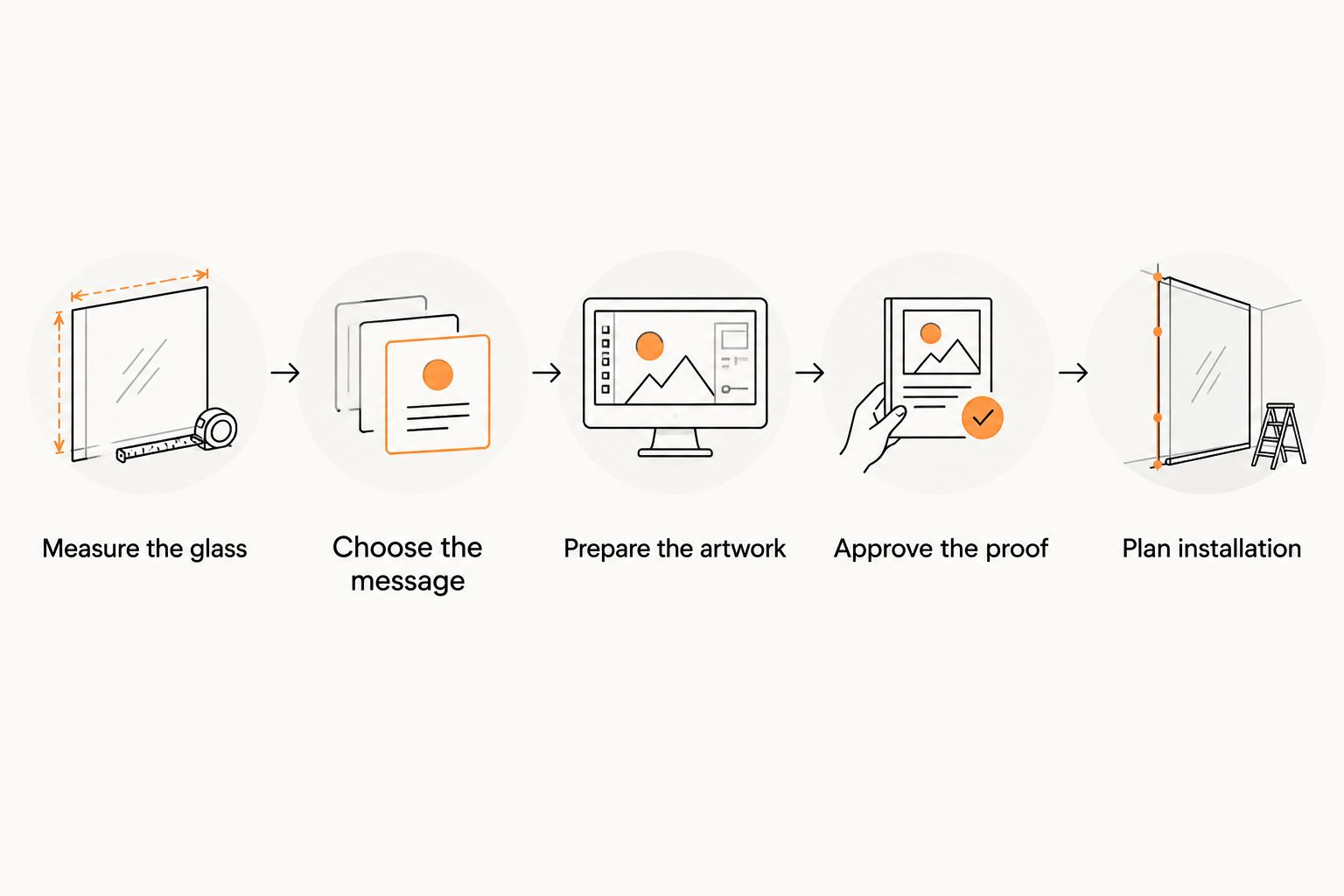
A bulk order starts with the vehicles and the message, not a quantity selector. Use this sequence before approving a custom windshield banner layout.
Measure the glass
Record the usable area for each windshield type. Mark trim, sensor areas and any location the banner must avoid, then make a paper mockup to check the proposed outline.
Do not approve a universal dimension solely because the design looks balanced on screen. Check the mockup from inside and outside the vehicle.
Choose the message
Assign one purpose to each design: identity, inventory grouping, event information, direct contact or scanning. Remove elements that do not support that purpose.
For a 2026 campaign, keep the editable artwork organized by message and vehicle fit. That makes later revisions easier to check against the correct version.
Prepare the artwork
Supply the clearest available logo artwork and confirm the printer’s file requirements. Specify the intended dimensions, orientation, cut shape and installation side rather than expecting the artwork alone to communicate them.
Check contrast against the glass. A matte-versus-glossy decision does not replace a readable layout or an application-specific material check.
Approve the proof
Review the dealership name, category wording, contact details and dates separately. For a QR design, scan the code and verify the destination before approving the artwork.
With Vinyl Status custom decals, confirm the proof and production requirements for the selected format before scheduling the display. Approval, production and shipping are separate steps; build your deadline around all of them.
Plan installation
Confirm surface preparation, application conditions and removal instructions with the supplier. Assign responsibility for installation and for removing outdated messages.
Choose quantities from actual display needs
Count the vehicles assigned to each design, then add only the spares your team has a reason to hold. Separate quantities by message and windshield fit.
For example, if a display requires 18 banners and your installation plan calls for 2 spare banners, the order is 20 banners for that design. This is an ordering example, not a recommended quantity for every dealership.
Test a full-size paper layout from 3 feet and 20 feet as two practical viewing checks. Use your actual display conditions to decide whether the main message remains readable; these distances are checks, not guaranteed performance specifications.
How the styles were ranked
The order follows the buying decision: establish dealership identity first, then consider inventory grouping, event messaging, direct contact or a scan-based action. It does not represent material testing or a claim of measured sales performance.
The criteria are message priority, glass fit, contrast, useful lifespan, application workflow and proof accuracy. A style earns its place by serving a distinct dealership task.
Which windshield banner style should you choose?
Choose a single-line wordmark if dealership identification is your only requirement. Move to an inventory label or event message only when that additional purpose is the reason for the order.
Vinyl Status is best for small businesses ordering custom decals from their own artwork. Confirm windshield suitability for the selected format before treating a general decal order as a vehicle-glass solution.
For your 2026 display plan, approve the message and the fit together. Neither a clear design on the wrong glass nor a well-fitted banner with unreadable text solves the ordering problem.
FAQ
What’s the best custom windshield banner style for a dealership?
A single-line wordmark is the clearest default when the purpose is dealership identification. Choose a category label, event message, contact detail or QR-led layout when the banner has that specific job.
What size should a dealership windshield banner be?
Size the banner from the usable area of the actual windshield. Check curvature, trim, sensors and visibility with a full-size paper mockup before approving dimensions.
Can I put a QR code on a windshield banner?
Use a QR code only when the layout supports a clear quiet zone, strong contrast and a successful scan at the final size. Test it on the parked vehicle in the intended position and lighting.
Should I choose matte or glossy for a windshield banner?
Choose the finish after confirming the material is suitable for the intended glass application. Compare glare and artwork readability in the display setting rather than selecting a finish by name alone.
How many promotional windshield banners should I order?
Order from the number of assigned vehicles plus a justified spare quantity. Count each message and windshield fit separately so an excess of one design does not hide a shortage of another.
Can a promotional windshield banner stay on while driving?
Do not assume a display banner is suitable for driving. Check applicable windshield-obstruction rules and the product’s application instructions before road use.
What should I check before approving a windshield banner proof?
Check dimensions, spelling, cut boundaries, orientation and every contact detail. Confirm event dates and scan any QR code before approval, then schedule production and shipping as separate stages.
One last thing
Print the artwork on paper at its intended size before ordering the batch. Put it against the intended glass, step back and ask someone who did not design it to read the main message. Remove whatever competes with that message before approving the production proof.
Related guides