

Custom stickers no minimum: when a small batch makes sense

Custom stickers with no minimum make sense when you need to check artwork, size, or packaging fit before committing to a larger order. Treat the first batch as a test, not proof that the smallest quantity is the right choice for repeat packaging or giveaways; check the supplier’s quantity rules, artwork review, and proof process before ordering.
- Custom stickers no minimum suit artwork tests and uncertain demand; repeat packaging needs a quantity based on actual use.
- Vinylstatus serves small businesses ordering custom printed stickers from their own artwork.
- Check physical size, cut shape, and packaging placement before approving the proof.
- Keep production after proof approval separate from shipping when planning your deadline.
When do custom stickers with no minimum make sense?
Start small when the order needs to answer a specific question. A small batch is useful when you have not settled the logo size, tested the application surface, or confirmed that customers will take a giveaway.
Use these 3 checks before deciding:
- Name the uncertainty. Write down what you need to learn: whether the logo reads clearly, whether the shape fits, or whether the sticker suits its intended use.
- Choose a test setting. Apply the sticker to the actual box, bag, or product packaging. A screen preview cannot show how a sticker sits across a fold.
- Define the reorder decision. Decide what would justify repeating the design and what would require an artwork change.
For a small business ordering custom printed stickers from its own artwork, Vinylstatus is a relevant print-shop option. Confirm the selected product’s minimum quantity and order process before treating it as a no-minimum option.
Why this matters
A small order protects you from repeating an untested decision across more packaging. It does not replace artwork preparation or careful proof approval. The first batch only earns its place if you inspect it and use what you learn.
For your 2026 packaging plan, separate experiments from routine supplies. A revised logo belongs in the testing category; an unchanged design used on every outgoing box belongs in demand planning.
That distinction also keeps the order useful. A handful of stickers with no defined purpose is leftover stock, even if the initial commitment is small.
Small batch or bulk order: which fits the job?
Choose the quantity around the job, not around the phrase “no minimum.” The phrase describes an ordering condition. It does not tell you whether the artwork, finish, or quantity matches your business needs.
| Order approach | Best for | Practical advantage | Limitation | Next move |
|---|---|---|---|---|
| Small batch | Testing a new logo, placement, or giveaway | Lets you inspect the result before repeating it | Does not establish long-term demand | Record what worked before reordering |
| Bulk order | An approved design with a defined packaging use | Supplies an established, repeat task | Commits you to the current artwork | Calculate quantity from expected use |
Neither approach fixes an unclear design. If your business name disappears at the intended size, ordering fewer copies leaves the same readability problem.
A bulk order also needs a reason beyond wanting spare stickers. Identify where the stickers will go, who will apply them, and how often you use them. Those answers turn a quantity choice into an operating decision.
Small batches: best for testing a specific detail
A small batch is a sensible choice when a real object can settle a design question. Packaging is a good example: you can inspect whether a label covers an opening, crowds required information, or sits awkwardly near a seam.
Keep the test narrow. If you change the artwork, shape, and placement together, you cannot tell which change improved the result. Start with the detail that could force a redesign.
For a giveaway, define the intended recipient and setting. A sticker handed to customers at checkout has a different distribution plan from one inserted into shipped orders. Test the plan as well as the print.
The limitation: a small batch shows how that batch performs in its test setting. It does not establish demand for every event or packaging application in your 2026 calendar.
Bulk orders: best for an approved, repeatable use
A larger order makes sense after you have approved the design and can explain the quantity. Routine packaging provides a clear starting point: count the packages that will actually receive a sticker, then account separately for other uses.
Do not mix confirmed packaging demand with an undefined giveaway allowance. Keep those uses separate so you can see what the order needs to cover.
Before repeating an order, check whether the artwork contains details that could change. A dated event, temporary message, or old destination in a QR code can make otherwise usable stickers unsuitable for the next job.
The limitation: a larger quantity ties more of your order to the current design. Approve a repeatable layout before committing to repeated use.
Why the right order size varies
The useful quantity depends on the decision you have already made and the uncertainty that remains. Use these factors to separate a test order from a routine supply order:
- Artwork stability: an approved logo supports repeat ordering; an unresolved layout needs inspection first.
- Application surface: test on the actual packaging, including folds, curves, and seams that affect placement.
- Distribution plan: count intended uses rather than assuming every customer wants a giveaway.
- Time-sensitive content: event names and dated messages limit where leftover stickers remain useful.
- Proof changes: confirm the final version before multiplying it across an order.
- Reorder timing: leave room for proof approval, production, and shipping as separate stages.
Avoid using quantity to settle a design disagreement. Settle the design first, then choose how much of it your business can use.
What should you check before approving a small sticker order?
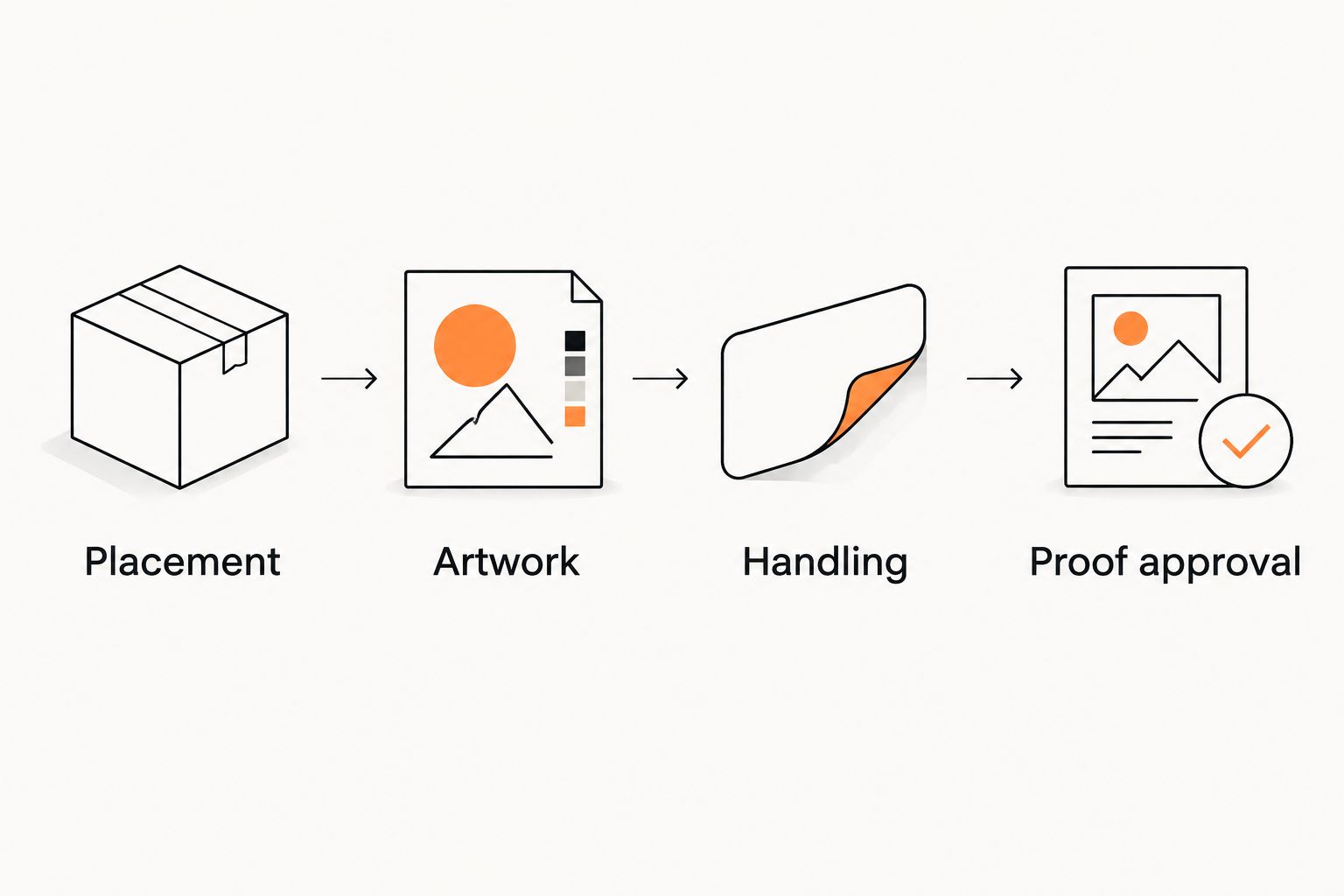
Use these 4 stages for a 2026 test order: placement, artwork, handling, and proof approval. Each stage addresses a different reason an attractive preview can fail to suit the job.
Placement
Measure the flat area where the sticker will sit. Check the packaging when it is filled and closed, not only when it lies empty on a desk.
Cut a plain paper outline at the intended dimensions and place it on the package. This checks footprint and positioning; it does not test adhesive, finish, or printed color.
Leave room for other information your packaging needs. A logo sticker should not obscure instructions, product identification, or information customers need to read.
Artwork
Review the artwork at its intended physical size. Enlarge the file to inspect details, then return to actual size to judge readability. A readable enlarged logo can still contain text that is too small for the finished sticker.
Check the outer cut shape separately from the printed design. For die-cut artwork, inspect narrow extensions and tight corners. Ask the printer to explain anything in the proof that you do not understand.
If the design includes a QR code, scan the intended layout and confirm its destination. Preserve clear space around the code, and avoid placing it across a fold or curved edge that interferes with scanning.
Handling
Think about the person applying the stickers. A packaging team needs a repeatable placement, not a design that requires careful improvisation on every box.
Ask whether the selected printed sticker has a split-back liner if easier peeling matters to your workflow. Confirm the feature for that product rather than assuming every sticker format uses the same backing.
Inspect the finish in the setting where the sticker will be seen. If reflected light interferes with reading the artwork, change the finish or layout before repeating the order.
Proof approval
Check the final proof against the intended use, not just against the uploaded file. Confirm spelling, orientation, dimensions, cut shape, and the version of the artwork you want printed.
Ask whether an online proof and human artwork check are included, and whether either requires a separate charge. Do not assume a preview is a physical sample or a guarantee of appearance on your packaging.
Approve only when the proof matches your intended order. Save the approved artwork and order details together so the next purchase starts from the correct version.
How should you plan production and shipping?
Production and shipping are 2 separate stages. When a printer states a production period after proof approval, that period does not describe the complete journey to your door.
For a 2026 event order, work backward from the date you need the stickers ready to use. Ask when production begins, how revisions affect that start, and what shipping time applies to your destination.
Keep proof review on your own calendar. An unanswered artwork question leaves the order unresolved even when your intended event date is fixed.
If domestic production matters to your purchasing decision, verify the manufacturing location for the selected product. Do not infer it from a business address or a shipping origin.
When should you reorder after a test batch?
Reorder after the test resolves the question you identified. Record whether the sticker fits, reads clearly, applies as intended, and serves its packaging or giveaway purpose.
Keep a short record of the approved artwork, dimensions, finish, and placement. Note changes you want before repeating the order. This prevents an old file from becoming the default simply because it is easy to find.
For your next 2026 order, calculate quantity from the uses you expect to repeat. Keep optional giveaways separate from stickers required for daily packaging.
Repeat an approved specification, not just an old order number. Check that the saved details still describe what your business needs.
FAQ
What does custom stickers no minimum mean?
Custom stickers no minimum means the seller does not require a minimum order quantity for the specified offer. Confirm which sticker format and order conditions the statement covers before ordering.
Does Vinylstatus offer custom stickers with no minimum?
Confirm the minimum quantity for your selected Vinylstatus sticker product before ordering. Do not treat a general search phrase as a product-specific ordering rule.
Is a small sticker batch better than a bulk order?
A small batch is better suited to testing an unresolved design or application question. A bulk order suits an approved design with a defined, repeatable use.
Can I approve sticker size from an online preview?
Check sticker size against the actual packaging before approving it. A paper outline helps you judge footprint, while a printed test is needed to inspect the finished sticker.
What should I check on a sticker proof?
Check spelling, artwork version, dimensions, orientation, and cut shape on the final proof. For QR-code artwork, confirm the destination and scan the layout before approval.
Does production time include shipping?
Treat production time and shipping time separately unless the supplier explicitly states otherwise. Confirm whether production begins after proof approval and plan for delivery after that stage.
How do I choose a useful reorder quantity?
Base the reorder quantity on the packaging and giveaway uses you expect to repeat. Separate required packaging demand from optional extras, and review any time-sensitive artwork before ordering.
One last thing
Keep an unused sticker from the approved batch with your order notes. Compare it with the packaging setup before repeating the design; a new box or revised label layout can change a previously sensible placement.
For a 2026 reorder, that physical reference gives you something concrete to check alongside the saved proof. The goal is not the smallest possible order. It is an order you can use without correcting the same mistake again.
Related guides