

Do holographic stickers fade outdoors?
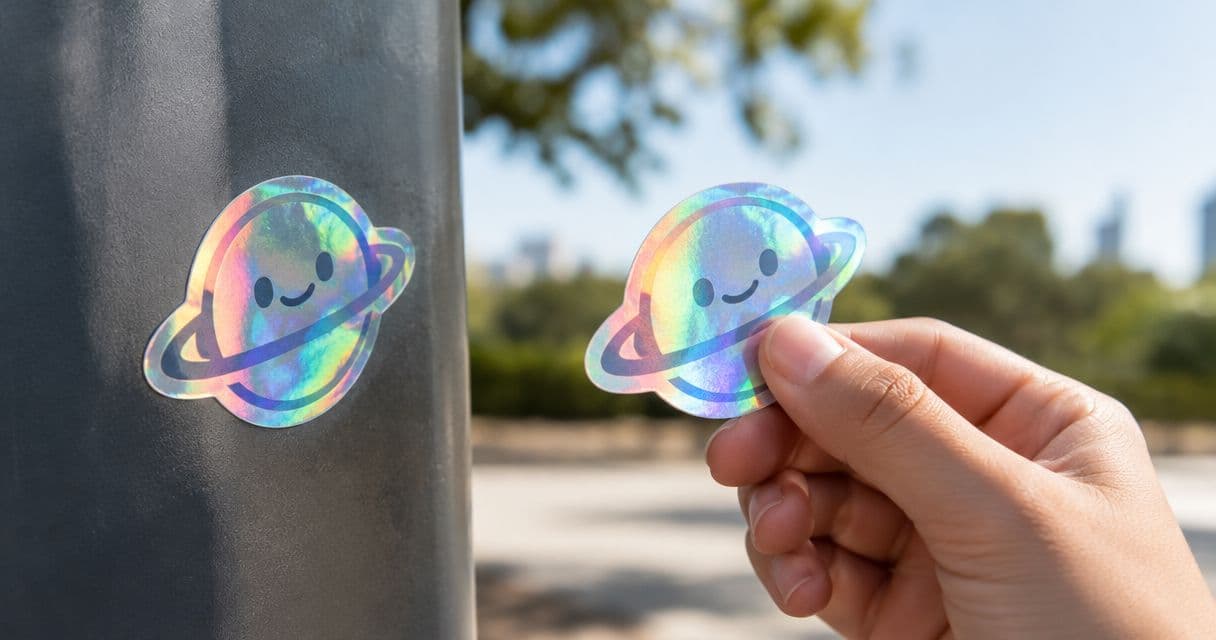
Yes, holographic stickers can fade outdoors because sunlight can degrade printed colors; the reflective effect does not make the ink fade-proof. For your 2026 packaging or giveaway order, check the finished sticker’s outdoor-use specifications, because water resistance alone does not establish resistance to fading.
- Do holographic stickers fade outdoors? Yes. Sunlight can fade printed colors even when the reflective material remains visible.
- Holographic sticker durability depends on the ink, protective construction, exposure, and application surface.
- Vinyl Status custom sticker printing fits small businesses ordering logos, packaging, and giveaways from their own artwork.
- Approve artwork separately from outdoor suitability, and test the finished sticker where customers will actually use it.
Do holographic stickers fade outdoors?
Holographic stickers can fade outdoors, but there is no single outdoor lifespan that applies to every holographic sticker. The answer depends on the finished construction: the reflective material, the printed ink, and any protective layer over that ink.
A rainbow effect describes appearance, not an outdoor durability rating. A sticker can still reflect light after its printed logo has lost contrast. It can also remain colorful while its edges lift or its surface becomes scratched.
If you are preparing artwork for Vinyl Status, separate your design decision from your exposure decision. Choose the holographic effect because it suits the logo or giveaway, then confirm whether the finished sticker suits the intended outdoor use.
| Intended placement | Main advantage | Main limitation | Best for |
|---|---|---|---|
| Indoor packaging | Keeps the sticker away from direct outdoor weather | Does not demonstrate outdoor performance | Boxes, bags, and indoor displays |
| Sheltered outdoor placement | Reduces some direct exposure | Shade and shelter do not eliminate sunlight or moisture | Covered displays with a planned inspection |
| Fully exposed outdoor placement | Places the design where it is needed | Requires closer attention to sunlight, weather, and surface suitability | Uses supported by finished-product specifications |
Why this matters
A small-business sticker has a job: keep a logo readable, identify a package, or give customers something useful to apply. The relevant question is not simply whether the sticker survives. It is whether the printed message remains readable for the intended use.
Treat fading, peeling, and scratching as separate checks. A sticker that stays attached has not necessarily passed a color-retention test. A sticker that looks good on arrival has not yet demonstrated outdoor durability.
Why holographic sticker fading varies
Outdoor fading depends on several connected factors. Check these before you approve a bulk order rather than relying on a photograph of the reflective finish.
- Sunlight exposure: Ultraviolet radiation can degrade pigments and other components in a printed construction. A reflective surface does not remove that exposure.
- Exposure duration: Continuous outdoor use presents a different requirement from a sticker placed outside only during an event. Define the intended use before comparing specifications.
- Placement and shade: A sheltered surface and a surface receiving direct sunlight do not create the same exposure conditions. Describe the actual placement when asking about suitability.
- Ink and protection: Ink chemistry and protective layers affect how the printed image withstands exposure. Ask about the finished sticker, not just the base film.
- Weather and wear: Rain, temperature changes, cleaning, and abrasion introduce additional failure modes. Check those separately from fading so you can identify what actually changed.
Avoid turning one positive feature into a general durability claim. Water resistance addresses a different problem from color fading. Scratch resistance addresses another. Neither statement, by itself, establishes how long a printed logo will remain readable in sunlight.
Does the holographic effect protect the printed colors?
The holographic effect is not proof of UV protection. Its purpose is visual: it changes how the surface reflects light. Protection for the printed image depends on the materials and construction used in the finished sticker.
This distinction matters when your artwork leaves reflective areas exposed. The rainbow background and the printed colors are different parts of what you see. Judge both, rather than deciding that a sticker has retained its appearance because it still flashes in the light.
For a logo, inspect the brand name, fine lines, and small lettering first. A strong reflective effect cannot compensate for text that has become difficult to read. Keep a reference copy so you are comparing the print, not relying on memory.
Is a protective laminate enough?
A protective laminate can provide a barrier over printed artwork, but its presence does not establish a universal outdoor lifespan. The laminate’s own specifications and the complete sticker construction still matter.
Ask what the protection is intended to address: ultraviolet exposure, abrasion, moisture, or a combination. Do not assume every clear layer provides the same protection. If the answer only describes water resistance, the question about fading remains unanswered.
How should you test a holographic sticker outdoors?
Use a finished sample on the intended surface and compare it with a protected reference. This is a practical screening check, not a substitute for documented material specifications or a guarantee of long-term performance.
For a 2026 outdoor-use trial, record the application date, location, surface, and exposure conditions. Keep the record with the artwork version so a later reorder does not depend on recollection.
Follow 3 checkpoints: baseline, exposure, comparison
- Baseline: Photograph the unused sticker under consistent lighting. Save a matching sticker indoors, away from direct sunlight, as your reference. Identify the logo details that must remain readable.
- Exposure: Apply the test sticker to the intended type of surface using the supplied application instructions. Record whether the location receives direct sunlight, shelter, cleaning, or frequent handling.
- Comparison: Compare the exposed sticker with the reference under the same lighting. Inspect printed color, text contrast, reflective appearance, surface damage, and edge adhesion separately.
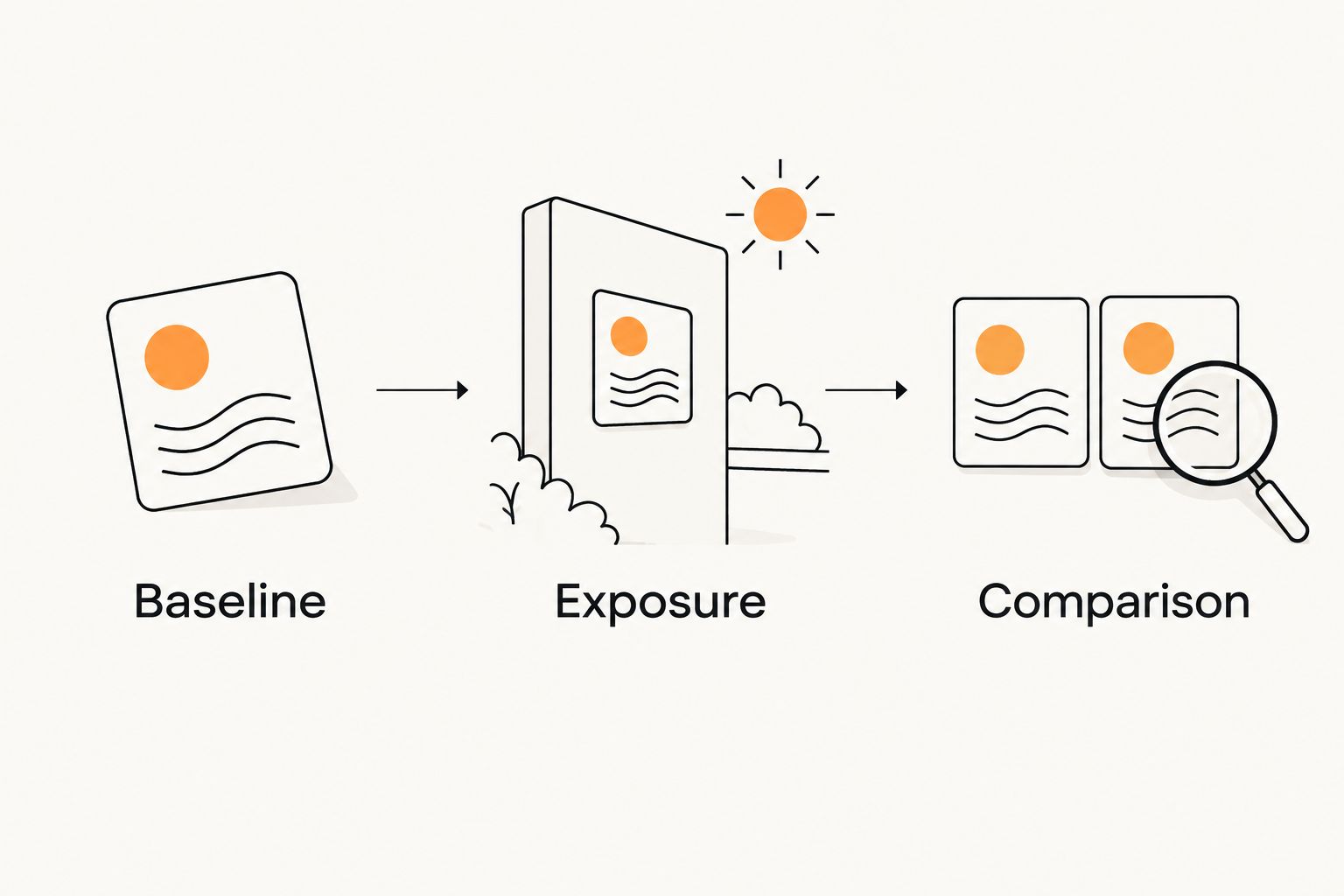
Start with 2 matching samples: one exposed and one protected. That gives you a direct comparison without requiring you to remember the original color. Use the same artwork and finished construction for both samples.
Do not call the test passed simply because nothing changed at the first inspection. Set inspection points around the intended use, and continue checking while the sticker is exposed. A short trial only describes what happened during that trial.
Test the finished printed sticker, not an unprinted piece of reflective material. Your business needs evidence about the logo customers will receive, including its colors, small text, and cut edges.
What should you check before ordering in bulk?
Build the order around the sticker’s business purpose. Packaging, event giveaways, and outdoor identification create different requirements even when they use the same logo.
Keep the following questions in your 2026 order brief. They make the durability discussion specific enough to support a buying decision.
Define the use
Write down where the sticker will go and what it must communicate. “Logo on an indoor shipping box” is a different brief from “logo on an outdoor display exposed to rain and sunlight.”
For giveaways, avoid promising an outdoor lifespan unless the finished product’s specifications support it. You control the artwork and order quantity, but you do not control where every recipient applies the sticker.
Check size and artwork
Choose dimensions from the available placement area, then inspect the artwork at that actual size. Enlarging the proof on a screen can hide the fact that small lettering will be difficult to read on the finished sticker.
Use reflective areas deliberately. Keep essential words distinguishable from their background, and check how the logo reads when the viewing angle changes. The effect should support recognition rather than carry the entire design.
Review the proof
Use free online proofs and human artwork checks to resolve print-layout questions before approval. Inspect the cut line, orientation, spelling, small text, and the relationship between printed and reflective areas.
Proof approval confirms the artwork you intend to print; it does not prove outdoor fade resistance. Keep the durability question separate, and request finished-product information rather than expecting a digital proof to answer it.
Separate production from shipping
Confirm the current production terms for the selected format and when that production clock begins. Production after proof approval and shipping are separate stages; neither should be treated as the complete delivery schedule.
Resolve the exposure question before approving a deadline-sensitive order. Otherwise, you risk approving artwork for a product whose intended use has not been settled.
Set a useful quantity
Base the quantity on planned packaging, event distribution, or another defined use. A larger order does not resolve uncertainty about outdoor performance; it simply commits more stock to the same untested assumption.
If outdoor use is central to the project, settle the material question before committing to the full quantity. Keep the approved artwork, specifications, and test notes together for the next order.
Plan your sticker order
Prepare your artwork, placement details, and outdoor-use questions before approving a bulk order.
Where should you place holographic stickers outdoors?
Choose a surface that matches the adhesive’s application requirements and the sticker’s stated use. Do not assume a textured, flexible, dirty, or damp surface will behave like a clean, smooth test panel.
Follow the supplied preparation instructions. Keep the sticker away from moving joints, sharp transitions, and areas that receive repeated scraping unless the intended application supports those conditions.
A sheltered location can reduce direct weather exposure, but it is not a substitute for suitable materials. Behind-glass placement also deserves its own check: glass does not automatically make a printed sticker immune to sunlight-related change.
Can I use holographic stickers for outdoor giveaways?
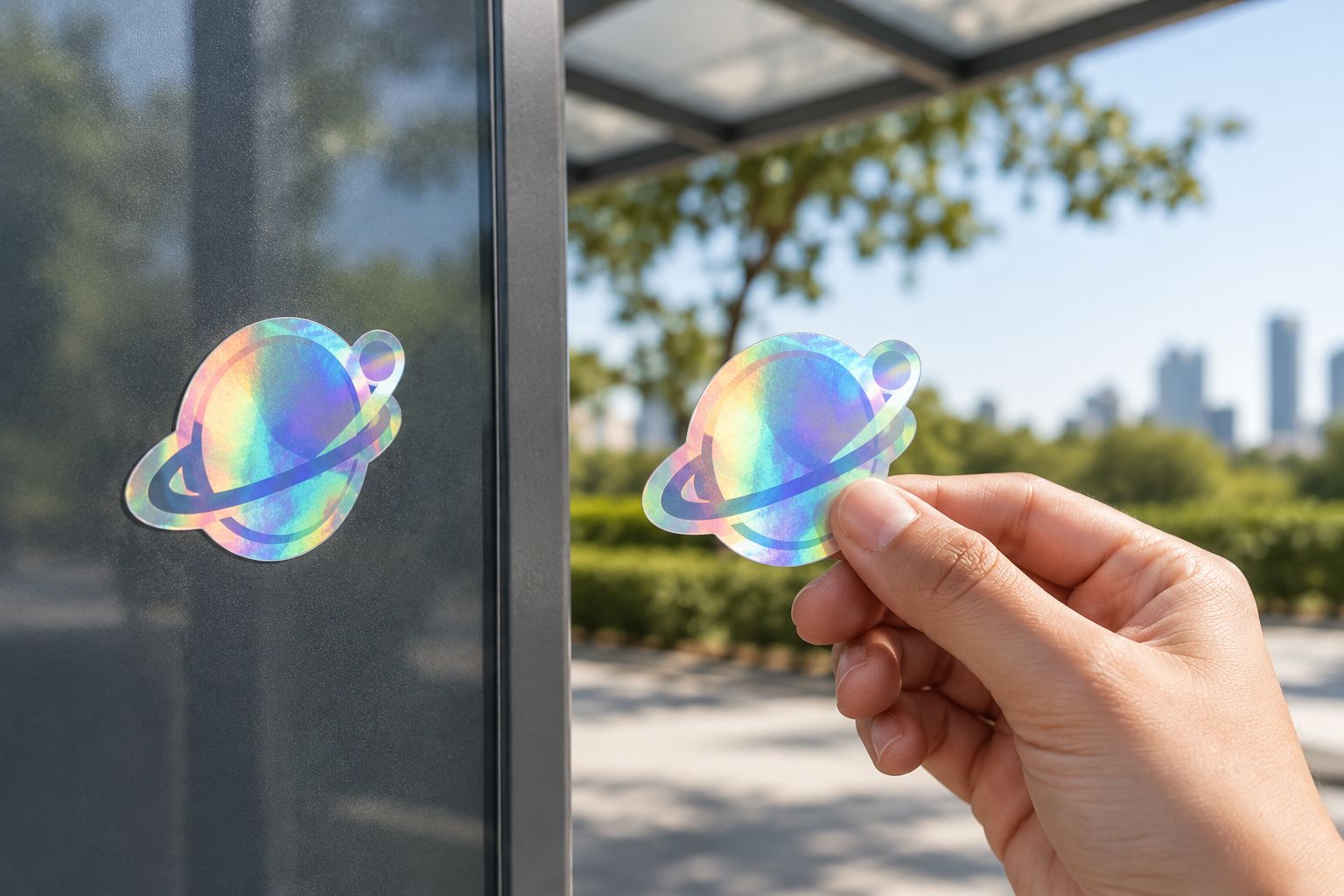
Holographic stickers can be considered for outdoor giveaways when the finished construction supports that use. For Vinyl Status custom sticker orders, describe the expected application before approval rather than treating the reflective finish as a durability specification.
The trade-off is straightforward: the reflective appearance adds a visual effect, but it does not remove the need to check outdoor suitability. Keep any durability statements on your packaging or giveaway materials within the documented product claims.
Will a larger logo prevent fading?
A larger logo does not prevent fading. It can make lettering easier to read at the intended viewing distance, but size does not change the printed ink’s resistance to sunlight.
Choose size for readability and placement. Choose materials and protection for exposure. Solving one problem does not automatically solve the other.
FAQ
Do holographic stickers fade outdoors in 2026?
Yes, holographic stickers can fade outdoors because sunlight can degrade printed colors. Check the finished sticker’s outdoor-use specifications rather than treating its reflective appearance as UV protection.
Are waterproof holographic stickers also fade-proof?
No, water resistance does not establish fade resistance. Ask separately about sunlight exposure, printed-color protection, and the intended outdoor application.
Will the rainbow effect disappear before the printed logo?
There is no universal sequence for changes to the reflective effect and printed logo. Inspect the printed colors, reflective appearance, and adhesion separately during an outdoor trial.
Does a clear laminate stop holographic stickers from fading?
A clear laminate does not automatically make a holographic sticker fade-proof. Its protective properties and the complete printed construction determine what claims are supported.
How can I check a holographic sticker before a bulk order?
Compare a finished printed sample outdoors with a matching reference kept away from direct sunlight. Record the surface and exposure, and inspect color, readability, surface damage, and adhesion separately.
Can a digital proof show whether my sticker will fade?
No, a digital proof cannot demonstrate outdoor fade resistance. Use the proof to check artwork and layout, and use finished-product specifications to assess outdoor suitability.
What should I ask Vinyl Status before ordering outdoor stickers?
Ask Vinyl Status whether the selected finished sticker supports your intended outdoor placement and what documented protection applies to the print. Provide the surface, sunlight exposure, artwork, and expected use so the question is specific.
One last thing
A sticker can remain attached and reflective while its logo becomes harder to read. Make readability the acceptance check, not simply whether the sticker is still there.
For your 2026 reorder, retain the protected reference alongside the approved artwork and exposure notes. That gives you a concrete basis for deciding whether to repeat the order, adjust the design, or ask for a different construction.