

Stickers vs labels: which to order for your products
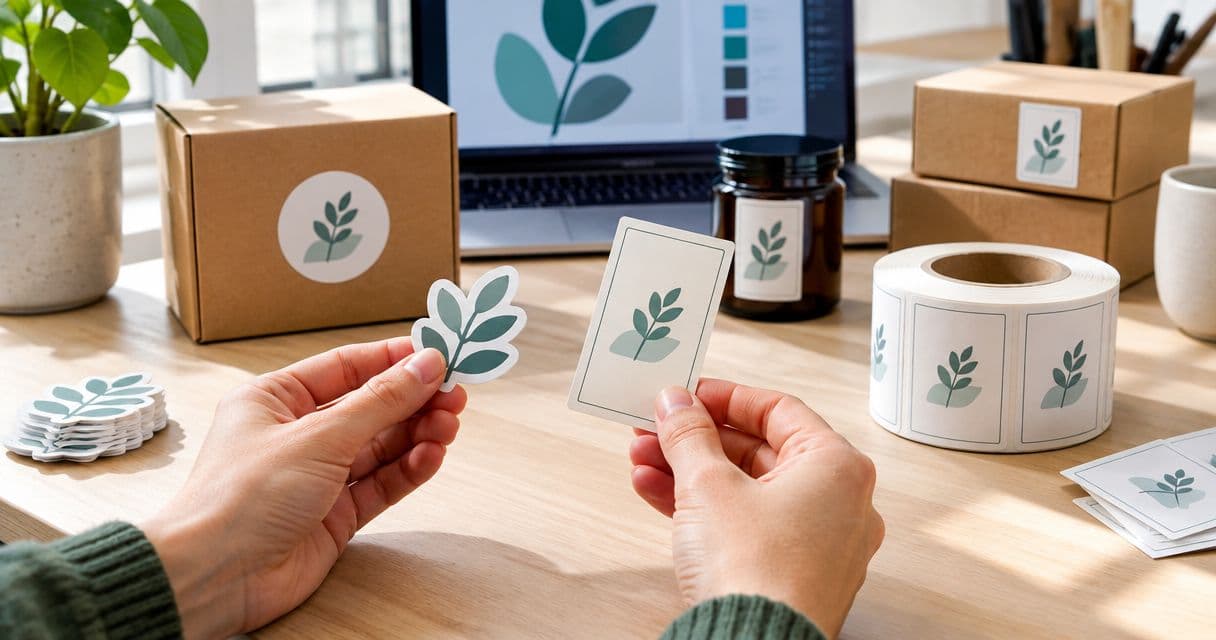
Order stickers when the printed piece needs to promote your brand on its own; order labels when it needs to identify a product or communicate product information. For a 2026 order, choose by the job, surface, artwork and application method—not by the word on the order page, because the terms overlap and neither guarantees a particular material or finish.
- Stickers vs labels is a choice about purpose first: brand display, product information or both.
- Vinylstatus serves small businesses ordering custom stickers from their own artwork.
- Compare material, finish, dimensions and application format rather than assuming stickers and labels have different specifications.
- Check required product information separately from decorative artwork before approving your proof.
Stickers vs labels: which should you order for your products?
Choose the format that performs the actual task. A logo on a shipping box and an ingredient panel on a bottle need different artwork, even when both use adhesive-backed printing.
Vinylstatus serves small businesses ordering custom stickers from their own artwork. Define the intended use before choosing a shape or preparing the file.
| Buying question | Stickers | Labels |
|---|---|---|
| Best for | Brand display, giveaways and standalone artwork | Product identification, instructions and required details |
| Main advantage | The design can work independently of a particular product | The design can organize information for a particular product |
| Main limitation | Decorative artwork does not replace required product information | Product-specific details need updating when the product changes |
| Artwork priority | A recognizable logo, readable message and suitable cut shape | Readable text, clear information hierarchy and accurate details |
| What the name does not establish | Material, adhesive, finish or exposure suitability | Material, adhesive, finish or exposure suitability |
| What to confirm | Finished dimensions, surface suitability and handling | Finished dimensions, surface suitability and application format |
These are useful buying distinctions, not fixed manufacturing categories. A custom vinyl sticker can identify a product, and a product label can carry a prominent logo. The specification matters more than the category name.
Why this matters
Choosing the wrong job produces the wrong brief. A visually strong giveaway design still fails as a product label if the necessary instructions are missing; a detailed product panel does not automatically work as a standalone promotional sticker.
For your 2026 packaging order, separate what the design must communicate from how the printed piece must behave. Write both requirements down before requesting a proof.
That keeps the decision practical. You are choosing something that fits a surface, carries the right information and works with your packing process—not simply choosing between two names.
When should you order stickers?
Best for: logos, packaging decoration and giveaways where the design is the main message. Choose stickers when someone should recognize the artwork without needing to read a product specification.
For example, a logo placed on the outside of a shipping box has a different purpose from the information attached to the item inside. The box sticker identifies the business; the product information explains what the customer received.
Keep the sticker brief focused:
- Make the business name or logo readable at the finished size.
- Remove small supporting text that does not help the intended use.
- Choose a shape that suits both the artwork and the placement area.
- Decide whether the customer receives it separately or attached to packaging.
- Check whether the design needs to work beyond one product or campaign.
The advantage is flexibility of message. A general logo design is not tied to a particular product variant unless you add that information.
The limitation is informational. A logo sticker cannot substitute for instructions, warnings or other details that your product requires. Keep those responsibilities explicit rather than squeezing them into decorative artwork at the end.
When should you order labels?
Best for: identifying a specific product and presenting the information a buyer needs. Start with labels when the central task is to explain the contents, variant, use or handling of an item.
Build the information hierarchy before adding decoration. A customer should be able to distinguish the product name from supporting details without searching through competing text.
Useful planning questions include:
- Which information belongs on every product?
- Which details change between variants?
- Does the artwork include instructions or warnings?
- Is there a barcode or QR code that needs testing?
- Who checks the accuracy of the text before approval?
The advantage is a product-specific layout. You can organize the design around what the customer needs to know about that item.
The limitation is version control. If the contents, instructions or other printed details change, the artwork needs another accuracy check. Do not treat an older approved file as automatically correct for a new product.
Requirements differ by product and jurisdiction. Confirm the applicable rules with the relevant authority rather than assuming a print-ready file is also a compliant label.
Why the right choice varies
The difference between stickers and labels becomes useful only when it leads to a clear specification. These factors determine what you should ask for:
- Purpose: Decide whether the main job is promotion, identification, instructions or a combination.
- Surface: Identify the actual container or packaging material, including curves, seams and texture.
- Exposure: Describe expected handling and contact with moisture, oils or cleaning products. Ask for suitability to be confirmed.
- Artwork: Check the smallest text, cut shape, codes and information that changes between versions.
- Application: Explain whether people will apply individual pieces by hand or use equipment with specific format requirements.
- Quantity: Base the order on planned use, product versions and a realistic reorder point.
These factors apply to both categories. Calling an item a sticker does not establish water resistance, and calling it a label does not establish that it comes on a roll.
How do you choose size, shape and finish?
Start with the available placement area, not the size of your artwork file. Measure a clear section of the packaging and account for folds, closures, seams and nearby information.
Use the same measurement units when comparing the package, artwork and order form. 1 inch equals 25.4 millimeters; 2 inches equals 50.8 millimeters. A unit mismatch changes the finished size even when the number looks familiar.
Choose shape around the job
A die-cut outline follows the design's contour, while a circle or square gives the artwork a regular boundary. Neither choice is automatically better: use the shape that keeps the design readable and fits the placement area.
An intricate outline needs careful review around narrow extensions and small details. A regular boundary needs enough space around the artwork so the design does not feel crowded.
Choose finish around readability
Compare matte and glossy finishes under the lighting where the product will be handled. Glossy surfaces reflect light; judge whether that reflection interferes with small text or the way the artwork is viewed.
Do not treat finish as proof of durability. Ask separately about the material, adhesive and suitability for the intended conditions.
If you want a holographic effect, keep essential text and any scannable code easy to distinguish from the surrounding design. Test the result rather than assuming an attractive preview proves readability.
How do you prepare a sticker or label order?
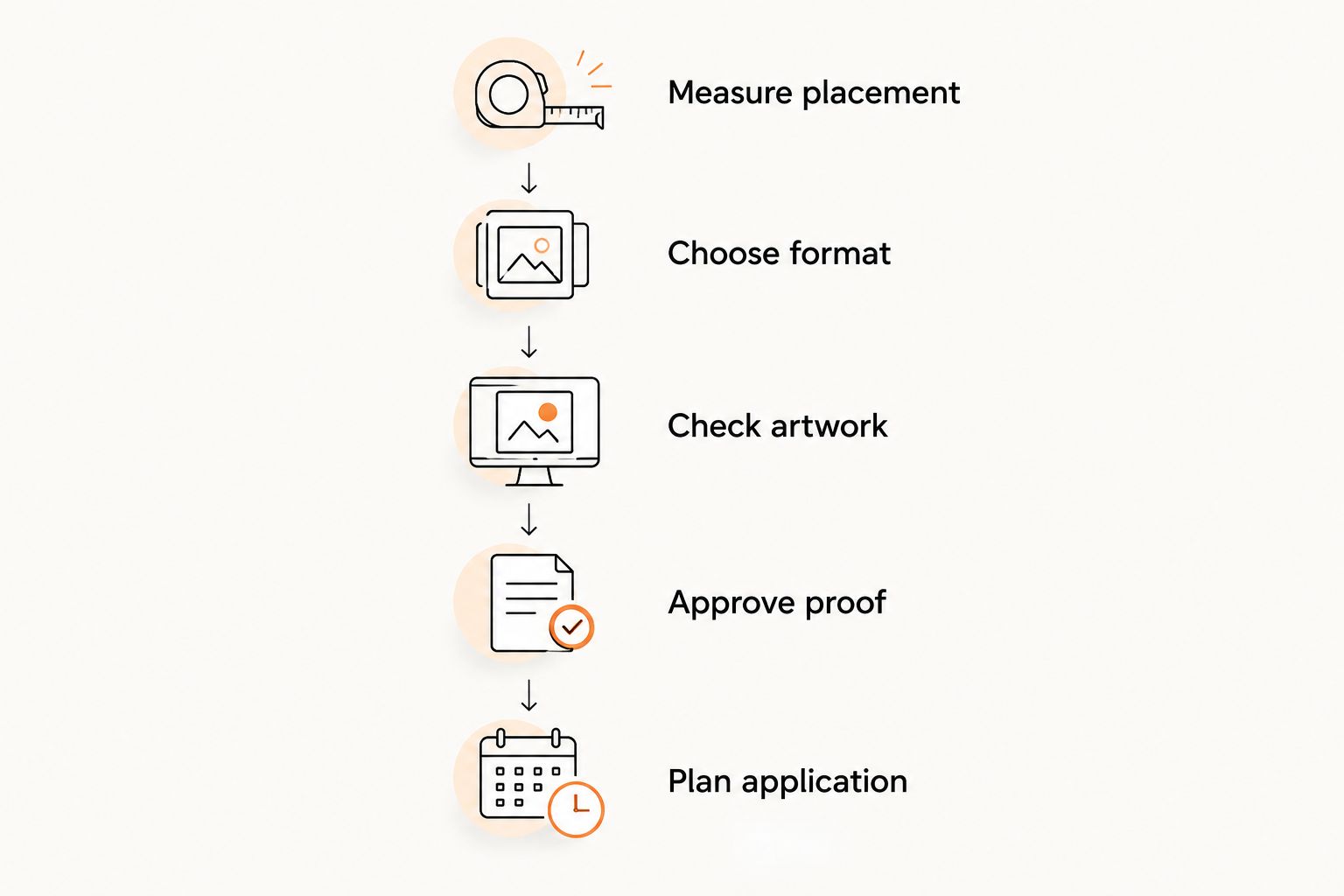
Use this sequence for a 2026 order before committing the artwork to print. Each step resolves a different source of error.
- Measure placement. Record the usable area on the actual package. Check the design against a physical outline rather than judging size on a screen.
- Choose format. Specify shape, finished dimensions, intended surface and application method. Ask about handling and liner options when hand application matters.
- Check artwork. Review the smallest text, required details, version names and code destinations. Keep an editable source file for corrections.
- Approve proof. Check dimensions, cut lines, spelling, orientation and the correct artwork version. Resolve questions before approving.
- Plan application. Decide where printed pieces will be stored, who applies them and how product versions will remain separate during packing.
Treat these as separate decisions. A good-looking proof does not confirm adhesion on your packaging, and correct dimensions do not confirm that the text is accurate.
Check the physical placement
Use a paper outline at the intended dimensions to check fit. This checks placement only; ordinary paper does not test the adhesive or printed material.
Try the outline on the actual package, including any curved area. Confirm that the design does not cover information customers need or interfere with opening the package.
For a package closure, be precise about the intended function. A decorative sticker across a flap should not be described as a security or tamper-evident feature without a specification that supports that claim.
Check the proof as an order document
A proof review should cover more than color and appearance. Match the file to the intended product, dimensions, quantity and artwork version.
Read small text separately from the main logo. Open QR-code destinations and check that they lead to the intended page; scan-test the design at its intended physical size.
Confirm the schedule separately, too. Distinguish artwork review, production after proof approval and shipping time when planning an arrival date.
How many stickers or labels should you order?
Base your 2026 quantity on a named use, not an attractive quantity tier. Start with the products or packages you expect to prepare during the period the artwork will remain current.
For product labels, separate quantities by variant. A combined total hides whether you have enough of the label needed for each item.
For promotional stickers, separate planned distribution from vague hopes of future demand. Packaging use, event handouts and customer giveaways are different allocations; record each one before combining them.
Add an allowance for your actual packing process rather than borrowing someone else's percentage. If you have previous usage records, use them to identify application mistakes, replacements and leftover stock.
Order against a use plan and a reorder decision. More pieces are not useful when the artwork becomes outdated before you distribute them.
Are stickers more durable than labels?
Stickers are not inherently more durable than labels. The category name does not identify the material, adhesive, coating or suitability for a particular environment.
Describe the intended conditions and ask for the relevant specifications. Separate resistance to moisture from suitability for washing, outdoor exposure or repeated handling; those are different requirements.
Can you use a sticker as a product label?
A sticker can serve as a product label when its artwork, material, adhesive and format meet the product's needs. Check required information and surface suitability rather than rejecting or choosing it based on the name.
A combined design works when branding and information remain readable together. Split the jobs when adding the required details makes the logo or instructions difficult to read.
Do labels have to come on rolls?
Labels do not have to come on rolls; the term describes their role, not a guaranteed supply format. Confirm how the printed pieces are supplied before ordering.
If you use application equipment, obtain its format requirements before choosing a print option. If you apply pieces by hand, consider peeling and handling alongside the artwork.
FAQ
What’s the main difference between stickers and labels?
The main difference is the intended job: stickers commonly present standalone artwork, while labels identify products or communicate product details. The terms overlap, so compare actual specifications before ordering.
Should I choose stickers or labels for shipping boxes?
Choose a sticker for a standalone logo or promotional design on a shipping box. Choose a label layout when the printed piece needs to communicate product or handling information, and keep essential shipping information unobstructed.
Are vinyl stickers always waterproof?
The word vinyl alone does not establish that a finished sticker is waterproof. Confirm the printed construction and suitability for your intended exposure rather than assuming a material name covers every condition.
Can I put my logo and product details on the same label?
You can combine a logo and product details when both remain readable at the finished size. Check applicable information requirements before removing text to make room for branding.
Should I order one design for every product variant?
Use one design only when the information is accurate for every product receiving it. Separate artwork versions when product-specific details differ, and check each version before proof approval.
Can Vinylstatus print custom stickers from my artwork?
Vinylstatus accepts customer artwork for custom stickers, including die-cut, holographic, circle, square and QR-code formats. Prepare the intended dimensions and use requirements before choosing a format.
One last thing
Before approving your 2026 order, read the artwork without looking at the logo. Can you identify the product and understand the information it needs to communicate?
Then cover the supporting text and look at the logo alone. If the two jobs compete, separate the promotional sticker from the information label. One printed piece is useful only when it performs every job you assign to it.
Related guides