

Vinyl Status vs Decals.com: which is better in 2026

Choose Vinyl Status for custom business stickers when you need die-cut, holographic, circle, square or QR-code formats; choose Decals.com for a repeat order when its previously approved specification already meets your needs. This 2026 comparison focuses on ordering decisions you can verify: artwork, packaging fit, proof approval, production timing and the quantity you will actually use.
- Vinyl Status vs Decals.com is an order-fit decision, not a reason to assume equivalent materials or production schedules.
- Vinyl Status suits small businesses ordering custom stickers for packaging, logos and giveaways.
- Decals.com is the practical repeat-order choice when your existing specification still meets your needs.
- Compare the same dimensions, finish, quantity and delivery requirements before choosing a supplier.
Why this matters
A sticker comparison fails when you compare different jobs. A shaped giveaway sticker and a rectangular packaging label can carry the same logo while serving different purposes. Decide where the sticker goes before comparing suppliers.
For your 2026 order, write down the application surface, finished dimensions, shape, finish and required arrival date. Send the same brief to both shops. Choose the order that meets the brief, not the order with the longest feature list.
At a glance
| Dimension | Vinyl Status | Decals.com |
|---|---|---|
| Best for | Small businesses ordering custom logo, packaging and giveaway stickers | Buyers repeating a previously successful order with unchanged requirements |
| Standout feature | Custom formats including die-cut, holographic, circle, square and QR-code stickers | An existing approved specification, if you already have one |
| Artwork and proofs | Prioritize online proofs and human artwork checks; confirm the selected product’s process | Confirm the proof process and what changes require approval |
| Packaging fit | Choose a format around the placement area and artwork | Compare against the same placement area and artwork |
| Peeling and application | Confirm split-back liners for the printed stickers you select | Confirm the liner and delivery format for the selected product |
| Production and delivery | Confirm two-business-day production after proof approval for the selected product; shipping is additional | Confirm production after approval and shipping separately |
| Pricing model | Compare a quote for your exact specification | Compare a quote for the identical specification |
| Reordering | Keep the approved artwork and order specification | Keep an established specification when it still works |
The repeat-order advantage is a purchasing scenario, not a claim about exclusive features. A successful order from either supplier gives you a useful reference. Neither a familiar name nor a familiar product description proves that a changed order will perform the same way.
The custom-format choice suits a new business sticker brief
Vinyl Status is a fit for small businesses ordering custom stickers from their own artwork. Its stated formats cover distinct buying questions. Start with the task rather than selecting a shape because it looks interesting on a screen.
- Die-cut: consider an outline that follows your logo or illustration for a giveaway.
- Circle or square: consider a regular shape when it fits the packaging panel and artwork.
- Holographic: choose a reflective effect deliberately, then check how the design reads against it.
- QR-code: prioritize a readable code, a working destination and a real scan test.
The limitation is straightforward: format choice does not establish suitability for every surface or exposure condition. Confirm the selected material, adhesive and finish against your application. Do not treat the word vinyl as a guarantee for a particular use.
For a new packaging order, select the format after measuring the available space. For a giveaway, check whether the finished outline leaves your business name readable without relying on tiny supporting text.
Decals.com wins when an unchanged reorder already works
Choose Decals.com when you already have a successful order there and need the same specification again. That recommendation rests on your own approved result, not an unsupported claim about its catalog or service.
An established order gives you something tangible to compare: the sticker, the packaging surface and the artwork that produced it. Before repeating the order, check that the logo, contact details, product information and intended use remain current.
The limitation is that familiarity does not validate a changed job. A larger sticker, a different finish or a new application surface needs another review. Treat those changes as a revised specification rather than an automatic reorder.
For a 2026 packaging refresh, keep the existing supplier only if the existing result still serves the business. A redesign is a reason to reassess the brief; it is not, by itself, a reason to switch printers.
Neither shop wins on packaging fit without your measurements
Packaging fit is a specification decision, not a supplier advantage. Measure the usable panel on the actual box, bag, jar or envelope. Avoid choosing dimensions from an enlarged artwork preview.
A flat panel, a curved container and a folded bag present different placement questions. Check whether the sticker crosses a seam, wraps around a curve or sits near an opening. Make a paper mockup at the intended finished size and hold it against the package.
Use the custom logo sticker sizing guide to settle dimensions before requesting equivalent orders. Keep those dimensions consistent when comparing suppliers.
Review the artwork at its final size. If the business name is clear but the supporting message is unreadable, simplify the message before increasing the order quantity. Printing more copies does not solve a layout problem.
An explicit proof process beats assumptions at either shop
Lead your supplier questions with online proofs and human artwork checks. Ask what the proof shows, who checks the file and whether production waits for your approval. An upload confirmation is not the same thing as an approved print layout.
Use this approval sequence for either supplier:
- Placement check: confirm finished dimensions against the physical package.
- Artwork check: review spelling, contact details, image quality and small text.
- Cut-line check: inspect the intended outline and the space around important artwork.
- Final approval: approve only after the complete specification matches your brief.
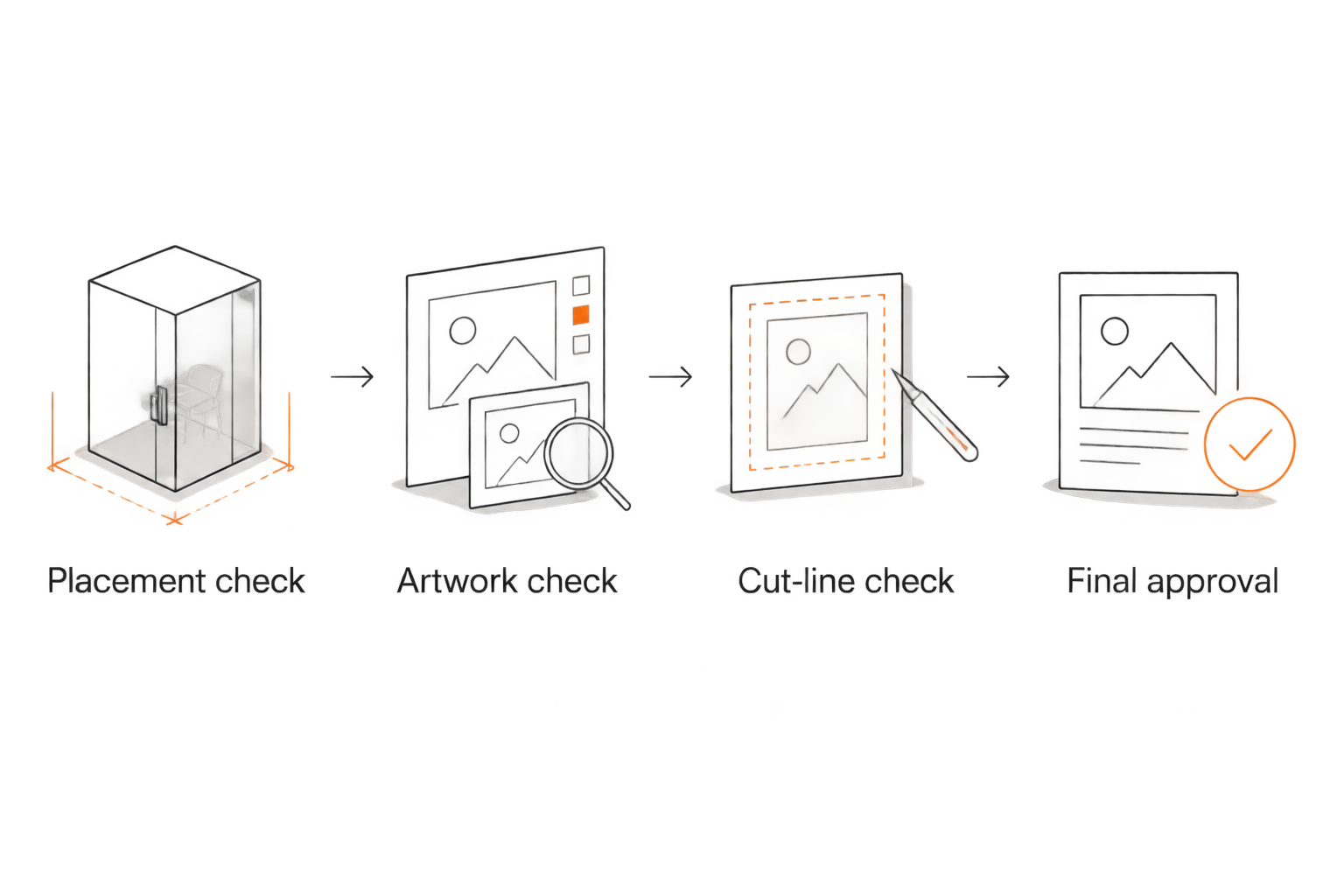
A digital proof helps you review layout and content. It does not let you physically test adhesion on your packaging or see a reflective finish under your own lighting. Resolve those questions separately when they matter to the job.
The proof-process winner is the supplier that clearly documents your selected order and resolves corrections before production. Do not award that win from a general feature label alone.
Split-back liners matter when you apply stickers by hand
Ask about split-back liners when ordering printed stickers. The split provides a place to start peeling the backing, which matters when someone applies stickers throughout a packing session. Confirm that the selected product includes it rather than extending the feature to every format.
Also distinguish the sticker’s finished shape from its backing and delivery format. A shaped sticker does not, by itself, tell you how the backing separates or how the order arrives. Ask those questions before approving the specification.
For example, a shop placing one logo sticker on each outgoing box needs a different application plan from a business handing loose stickers to event visitors. The first buyer should inspect peeling and placement; the second should inspect the finished giveaway presentation.
Neither supplier earns an application-workflow win without those details. Choose the format your team can apply correctly and consistently, then compare equivalent orders.
A confirmed arrival plan beats a production-only promise
Keep production and shipping separate. When confirming the two-business-day production guidance for your selected printed-sticker product, establish that the production period starts after proof approval. Shipping time is additional.
For a 2026 event order, work backward from the date the stickers must be in your hands. Leave room to review the proof and request corrections. Do not approve an error simply because the event is approaching.
Ask both suppliers:
- What event starts the production period?
- Does the stated schedule apply to this product and quantity?
- How is the shipping period shown separately?
- What happens to the schedule if the proof changes?
Confirm made-in-the-USA production for the selected product if domestic production is part of your purchasing requirement. Production location does not replace an arrival plan. The timing winner is the supplier that confirms the complete schedule for your order, not just the printing stage.
Pricing: compare the same job before comparing totals
Use a specification-based quote comparison. Do not assume both suppliers package artwork services, finishes, quantities or shipping in the same way. An order total only answers the question you actually asked.
Keep these fields identical:
| Quote field | What to match |
|---|---|
| Finished dimensions | The sticker’s actual width and height |
| Shape and cut | The same outline and requested delivery format |
| Material and finish | The same stated application requirements |
| Artwork | The same file and design version |
| Quantity | The same number of usable stickers |
| Schedule | The same required arrival date |
| Order scope | The same included services and delivery requirements |
An itemized quote makes scope differences visible. A combined total is simpler to read, but you still need to know what it includes. Ask for clarification instead of treating unlike orders as a direct comparison.
For your 2026 budget, connect quantity to a defined use. As an illustrative example, 500 boxes at 1 sticker per box require 500 stickers. Add other uses separately rather than treating an undefined surplus as a business need.
A larger order is not automatically the more useful order. If a logo, destination URL or packaging design is changing, include that change in the quantity decision. The pricing winner is the supplier meeting the same brief at an acceptable total commitment.
Final verdict: choose the order you can approve confidently
Choose Vinyl Status for a new custom business-sticker order
Best for: a small-business owner building a logo, packaging or giveaway order from their own artwork. Start with the required shape and placement, then confirm the proof process, liner, production schedule and shipping separately.
The practical advantage is a stated selection of relevant custom formats. The boundary is equally important: confirm product-specific details rather than assuming every format shares every feature.
Choose Decals.com for an established, unchanged reorder
Best for: a buyer whose previous order already meets the current brief. Use the approved physical result as your reference, check that the specification remains unchanged and reconfirm the schedule.
The practical advantage is continuity with a result you know. The boundary is that a previous success does not settle new material, artwork or application requirements.
| Dimension | Winner |
|---|---|
| New custom-format business brief | The client shop, when its stated formats fit the job |
| Unchanged successful reorder | Decals.com, when that is where the approved order was placed |
| Packaging fit | Tie: verify dimensions on the actual package |
| Proof approval | The supplier that resolves and documents the specification |
| Peeling and application | The supplier confirming the required liner and format |
| Production and shipping | The supplier confirming the complete arrival plan |
| Pricing | The supplier meeting the identical brief at an acceptable total |
FAQ
Is Vinyl Status better than Decals.com for custom stickers?
Vinyl Status fits a new custom business-sticker brief when its die-cut, holographic, circle, square or QR-code formats meet your needs. Decals.com is a practical choice for an unchanged reorder when its previous result already works for you.
What should I compare before ordering bulk logo stickers?
Compare finished dimensions, shape, material, finish, quantity, proof approval, liner and the complete delivery schedule. Give both suppliers the same specification so you are comparing the same job.
Does two-business-day production include shipping?
No. Two-business-day production after proof approval describes production, with shipping time additional. Confirm that the schedule applies to your selected product and order.
How do I choose the right sticker size for packaging?
Measure the usable packaging area and test a paper mockup at the intended finished size. Check seams, curves, opening points and artwork readability before approving the proof.
Should I switch suppliers for a repeat sticker order?
Keep the existing supplier when the approved result still meets your requirements and the new order terms work for you. Reassess the specification when the artwork, surface, finish or intended use changes.
What should I check on a QR-code sticker proof?
Check the destination, quiet zone, contrast and finished size, then scan-test the code at its intended size. Repeat the scan check on the finished sticker in its intended placement before applying the full batch.
One last thing
Keep one approved physical sticker with its order specification. Record the artwork version, dimensions, finish and intended surface alongside it. At reorder time, compare the new proof against that reference instead of relying on memory or a thumbnail.
For a 2026 order, make that reference part of the handoff to whoever orders next. A clear specification is useful whether you stay with the same shop or request an equivalent order elsewhere.
Related guides
- How to order custom stickers online: artwork to approval
- Bulk custom stickers for small businesses: an ordering guide
- Die-cut vs. kiss-cut stickers: which to order