

Waterproof stickers for water bottles: a 2026 buying guide
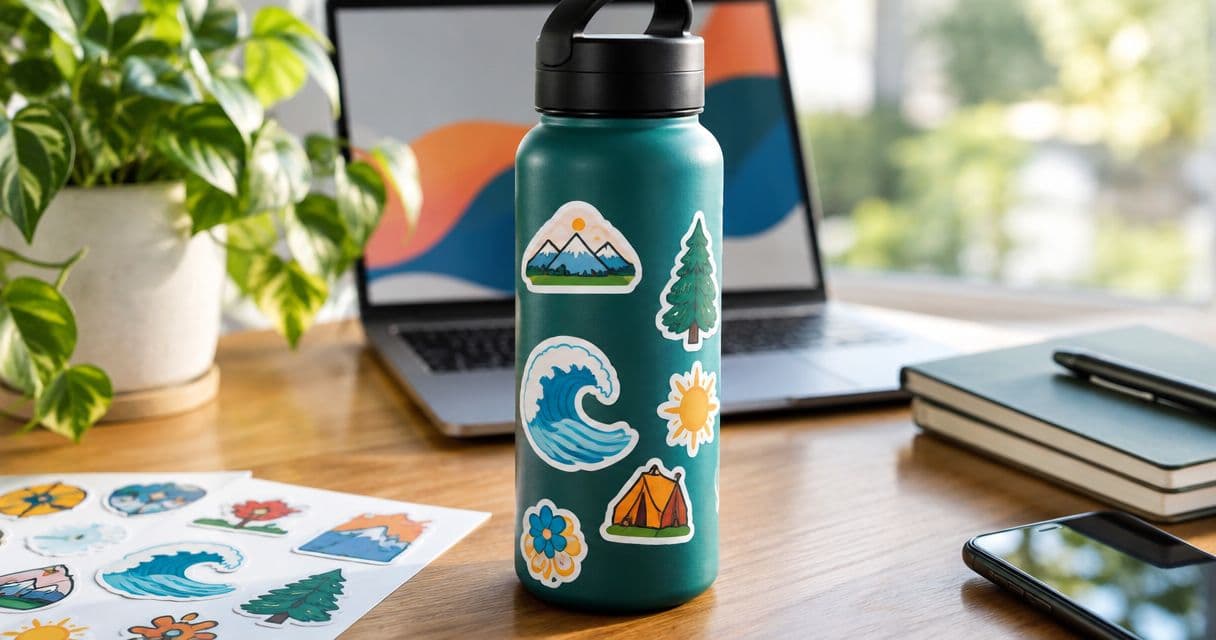
Small-business waterproof stickers for water bottles are custom labels designed for wet-use conditions, with the aim of keeping your logo readable on a reusable bottle. For a bulk order, choose the material, adhesive and care instructions before the shape or finish; waterproof does not automatically mean dishwasher-safe.
- Choose waterproof stickers for water bottles by material, adhesive and care instructions—not by finish alone.
- Vinylstatus serves small businesses ordering custom stickers from their own artwork; confirm water-bottle suitability before ordering.
- Test logo stickers on the actual bottle surface before committing to a bulk quantity.
- Treat dishwasher safety as a separate requirement from water resistance.
Why waterproof stickers matter for small businesses
A bottle sticker becomes part of a giveaway your customer handles, washes and carries. If the edge lifts or the printed logo becomes unreadable, the giveaway no longer does its job. A packaging label and a bottle sticker therefore need different buying checks, even when both use the same artwork.
For your 2026 order, start with the bottle rather than the sticker catalog. A smooth bottle wall, a textured coating and a sharply curved shoulder present different application conditions. The right sticker is the one that suits the actual surface and intended care routine.
Vinylstatus is a fit for small businesses ordering custom stickers from their own artwork. For water-bottle use, confirm the selected format’s material, adhesive, finish and care guidance rather than assuming every custom sticker has the same specifications.
How to plan a water-bottle sticker order
1. Define the bottle and its washing routine
Decide whether you are decorating bottles before distribution or giving customers loose stickers. Pre-applied stickers let you control placement and preparation. Loose stickers give recipients more choice, but you cannot control the surface they select or how they wash it.
Write down what the sticker must withstand. Condensation, splashes, hand washing, soaking and dishwasher cleaning are different conditions. A waterproof description alone does not establish suitability for all of them.
For a 2026 event giveaway, give the supplier a plain-language use description: reusable bottles carried daily and cleaned according to the bottle manufacturer’s instructions. Ask which sticker specification matches that use.
- Identify the bottle material and surface coating.
- Separate condensation exposure from washing requirements.
- Decide whether staff or recipients will apply the stickers.
- Ask specifically about dishwasher use if it is required.
- Keep the supplier’s care instructions with the order record.
2. Check the complete sticker construction
A sticker is more than its face material. The printed surface, any protective layer and the adhesive all affect whether the finished piece suits a water bottle. Ask about the finished printed sticker, not simply whether vinyl itself tolerates water.
A finish name is not a care instruction. Glossy, matte and holographic describe appearance; none independently proves dishwasher safety. Likewise, a protective laminate does not answer every question about adhesive performance on a particular bottle coating.
Request product-specific information in writing. If the supplier distinguishes water-resistant from waterproof, ask what conditions each description covers. Do not replace a clear answer with a guess based on a product photograph.
- Confirm the face material used for the selected format.
- Ask whether the printed surface has a protective layer.
- Confirm the adhesive’s intended surfaces.
- Check restrictions involving soaking, heat or washing.
- Separate verified specifications from decorative finish descriptions.
3. Choose the shape around the logo
Start with your existing artwork and its job. A simple circle can frame a compact logo, while a die-cut outline follows an irregular illustration. A square gives a rectangular composition a predictable boundary. Choose the format that keeps the business name readable without crowding the edge.
Vinylstatus offers custom die-cut, holographic, circle, square and QR-code stickers. Those formats answer different design questions; the format name alone does not confirm suitability for a bottle. Check the relevant product specification before treating any option as a waterproof choice.
For a 2026 logo refresh, avoid adding a slogan, social handle and website simply because space remains in the file. Every extra element competes with the name customers need to recognize.
- Use a circle for a compact, centered composition.
- Use a square when the artwork needs a defined frame.
- Use die-cut when the outer silhouette contributes to recognition.
- Consider holographic only when the reflective effect supports legibility.
- Remove details that disappear at the intended printed size.
4. Measure the placement before setting the size
Measure the usable wall of the actual bottle. Avoid deciding from bottle capacity alone: capacity does not describe the shape or width of the application area. Keep the sticker clear of seams, pronounced ridges and areas where the surface changes direction sharply.
Print paper mockups at 2 inches wide and 3 inches wide as comparison sizes, not universal recommendations. Hold each against the bottle and inspect the logo at its actual size. A smaller design that sits flat is more useful than a larger design that wraps into an awkward position.
Check the cut outline as carefully as the artwork. Narrow points and small protrusions create edges that deserve attention during handling and application.
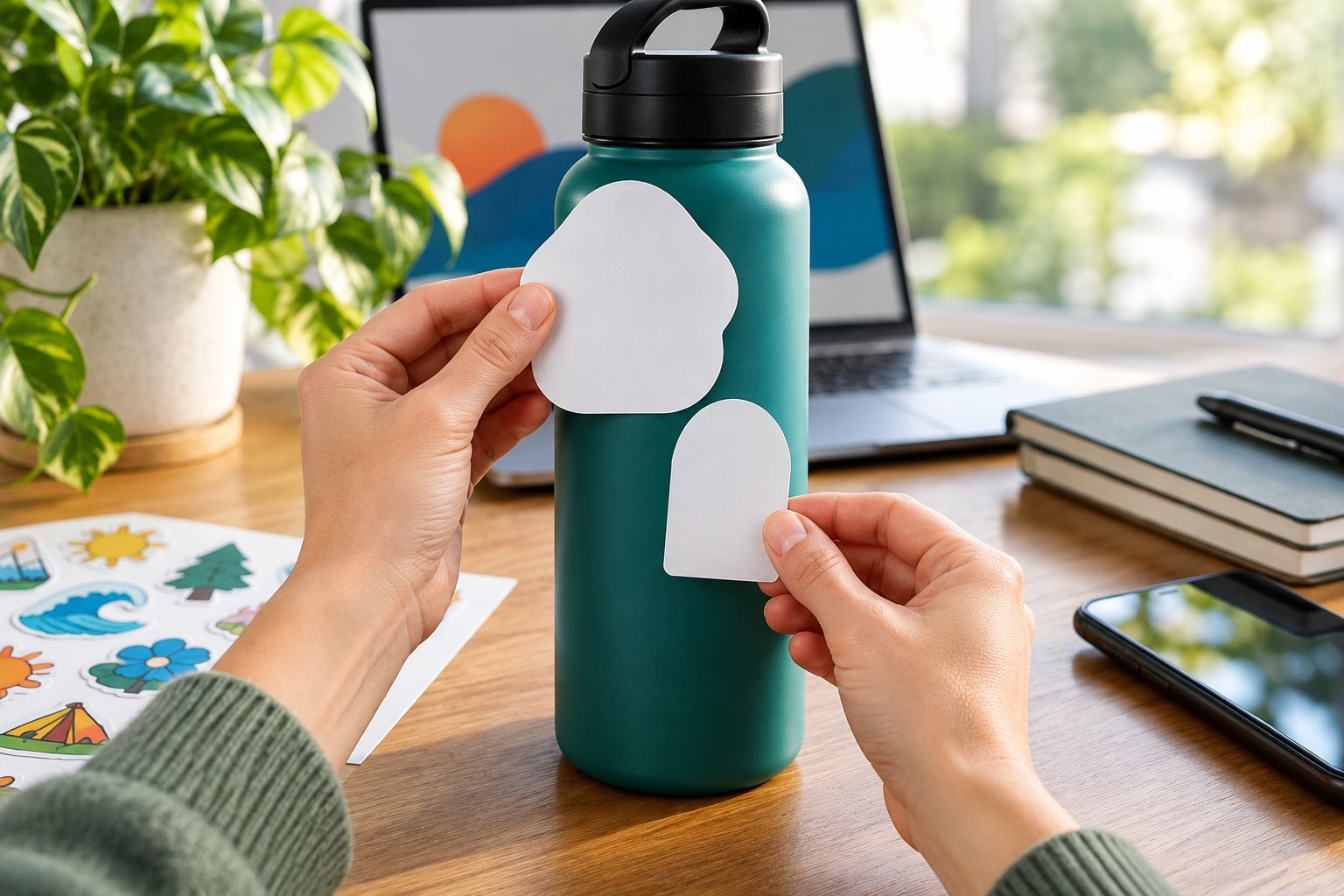
A paper mockup checks layout and fit only. It cannot tell you how the finished sticker adhesive, print or protective layer will behave when wet.
- Measure the usable application area on the bottle.
- Compare actual-size paper mockups.
- Keep important artwork away from the cut boundary.
- Inspect thin points and narrow sections of the outline.
- Record the approved dimensions with the artwork file.
5. Prepare the artwork and inspect the proof
Send artwork that remains clear at the chosen size. Vector artwork is useful for logos because it scales without the pixelation associated with enlarging a small raster image. If you use a raster file, follow the supplier’s resolution requirements at final print size.
Ask whether the order includes a free online proof and a human artwork check. Those are useful ordering questions, not substitutes for your own approval. A digital proof can show layout and cut placement, but it cannot reproduce the exact feel or reflected appearance of a physical finish.
For your 2026 approval, inspect the smallest lettering first. Then check the spelling, cutline, background and any QR-code destination. Keep the approved proof so a later reorder has a clear reference.
- Supply the cleanest original logo file available.
- Check text at the actual intended print size.
- Inspect the cutline and required artwork margins.
- Verify spelling, contact details and QR destinations.
- Ask what the artwork check covers before approving.
6. Test application and care on the real bottle
A physical sample answers questions a digital proof cannot. Use the same bottle model and surface finish planned for the giveaway whenever possible. A successful application on smooth glass does not establish the same result on a textured coating.
Follow the sticker supplier’s preparation and application instructions. Use only cleaning methods compatible with the bottle’s finish, and respect any stated waiting period before wet exposure. Do not invent a cure time when the supplier has not provided one.
Then use the bottle in the intended way. Check the edges, print and readability after the relevant handling and washing conditions. This is a practical suitability check, not a basis for publishing a broader durability claim.
- Request a physical sample or test order when offered.
- Apply it to the actual bottle surface.
- Follow the stated preparation and application instructions.
- Check edge adhesion after the intended care routine.
- Photograph problems and resolve them before the bulk order.
7. Set the quantity and work backward from delivery
Base the quantity on an identified use: bottles already purchased, expected giveaway recipients or actual demand for loose stickers. Keep those uses separate. A sticker applied to every bottle and an optional sticker placed on a counter have different quantity requirements.
Use a 30-day planning window if you need a manageable starting point for a recurring giveaway. Count the bottles or handouts planned within that period, then add only extras with a defined purpose, such as application practice or replacements. This is an ordering method, not a demand forecast.
For a 2026 event, distinguish artwork preparation, proof approval, production and shipping. Ask when production starts and confirm transit separately. Do not treat a production turnaround as an arrival promise.
- Count committed bottles separately from optional handouts.
- Assign a purpose to every extra quantity.
- Confirm whether the sticker design will remain current.
- Check peeling instructions if staff will apply the order.
- Record proof approval, production and shipping milestones separately.
Compare sticker options for bottle giveaways
Choose the design format after confirming the material and care requirements. These options describe buying approaches, not verified waterproof specifications for any particular supplier. Best for here means best fit for the stated design task—not a durability ranking.
| Option | Best for | Practical advantage | Key limitation |
|---|---|---|---|
| Circle or square with confirmed wet-use specifications | Simple business logos | A regular boundary makes layout planning straightforward | The frame can leave unused space around irregular artwork |
| Die-cut with confirmed wet-use specifications | Logos with a recognizable silhouette | The cut follows the artwork’s outline | Thin points and intricate edges need careful inspection |
| Holographic with confirmed wet-use specifications | Artwork where a reflective effect has a purpose | The changing appearance becomes part of the design | Reflections can compete with small text; inspect a physical sample |
| QR-code design with confirmed wet-use specifications | A specific destination such as care instructions or registration | Connects the physical bottle to a digital action | Requires scan testing at final size and on the curved surface |
For a plain business logo, start with the simplest format that preserves recognition. Choose a special effect only when it contributes something useful. A more complicated design creates more details to check without necessarily making the business name easier to read.
A QR-code sticker adds a separate obligation: the destination must remain useful. Keep the code away from severe curvature, preserve its clear surrounding area and test the finished placement with actual phones. A successful scan from a flat artwork file is not the same test.
Common mistakes small businesses make
Treating waterproof as dishwasher approval
Water exposure and dishwasher cleaning are not interchangeable requirements. Ask for explicit care guidance covering the intended washing method. If dishwasher use is essential and the specification does not address it, do not approve the order on the strength of the word waterproof.
Selecting the finish before checking the logo
A reflective effect or glossy surface can change how artwork reads under light. Check the business name and small text before choosing the finish. A physical sample is particularly useful when appearance depends on reflections rather than the flat colors shown in a proof.
Ordering for an ideal surface instead of the real bottle
A sample applied to a convenient surface does not answer the bottle question. Test the actual coating and placement. If recipients will apply loose stickers themselves, avoid promising identical performance across every bottle material and finish they might own.
Approving a screen-sized proof instead of a print-sized design
Large screen previews make small lettering look easier to read than it will be in print. Inspect the artwork at final dimensions and use a paper mockup. Check the smallest required detail, not just the overall shape of the logo.
Buying extras without a distribution plan
Unused stickers do not create exposure while they sit in storage. Tie the quantity to bottles, recipients or another defined use. For designs containing an event date, campaign message or QR destination, consider whether leftover stock will still have a job after the campaign ends.
FAQ
What’s the best material for waterproof stickers for water bottles?
Vinyl is a common starting point, but choose a finished sticker with confirmed water-exposure and care specifications. Check the printed surface, adhesive and compatibility with your bottle coating rather than relying on the material name alone.
Are waterproof bottle stickers dishwasher-safe?
Waterproof bottle stickers are not automatically dishwasher-safe. Dishwasher use needs explicit product-specific guidance because heat, detergent and washing conditions are separate considerations from ordinary water exposure.
What size should my business logo sticker be on a water bottle?
Choose the size from the usable bottle wall and the readability of your logo. Compare actual-size paper mockups, keep the design clear of pronounced curves and check the smallest lettering before ordering.
Is matte or glossy better for water-bottle stickers?
Neither finish establishes water resistance or dishwasher safety. Choose the appearance that keeps your artwork readable, then confirm the care specifications for that exact sticker construction.
Can I put a QR-code sticker on a curved bottle?
You can use a QR-code sticker on a bottle, but the finished placement needs scan testing. Preserve the clear area around the code, avoid severe curvature and test at final size with actual phones.
Can I order custom bottle stickers from Vinylstatus?
Vinylstatus accepts custom sticker orders from customer artwork. Confirm which selected format meets your bottle surface, water-exposure and care requirements before approving a bulk order.
What should I check before approving a bulk sticker proof?
Check the final dimensions, spelling, smallest text, cutline and artwork margins. Verify any QR destination separately, and use a physical sample to assess properties a digital proof cannot show.
One last thing
Test where the sticker ends, not just where the logo sits. The artwork can look correct while a corner, narrow point or outer edge lands on an unsuitable curve. Run your placement check around the entire cutline.
Keep a repeat-order record for your 2026 campaign: approved artwork, dimensions, selected construction, bottle model, placement photo and care instructions. When you reorder through Vinylstatus, use that record to confirm what should stay the same instead of relying on memory.