

Waterproof vs regular stickers: what matters outside
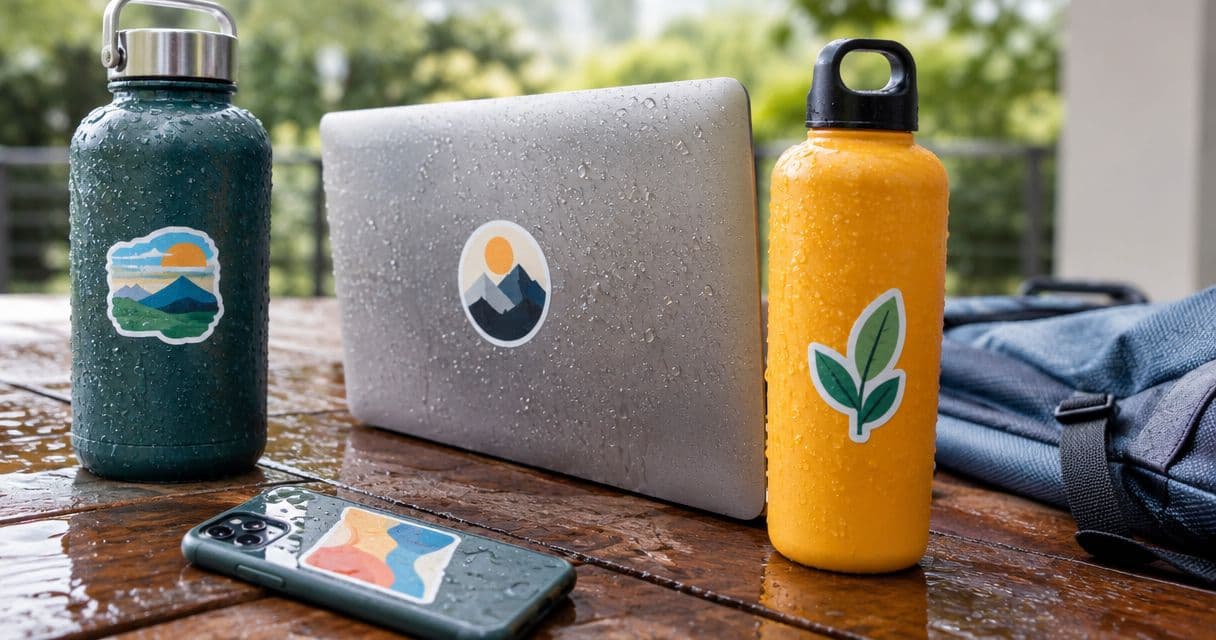
For outdoor use, choose stickers with verified water resistance, suitable adhesive and protection against sunlight—not a waterproof label alone. In a waterproof vs regular stickers comparison, the real difference is how the face material, printed design and adhesive handle the intended exposure together. A sticker that tolerates splashes does not automatically suit prolonged soaking, dishwasher cleaning or months of direct sun.
- Waterproof vs regular stickers comes down to material, print protection, adhesive and exposure—not the product label alone.
- Paper stickers suit dry packaging; outdoor vinyl stickers need verified water resistance and surface compatibility.
- Vinylstatus fits small businesses ordering custom vinyl stickers from their own artwork.
- Approve artwork separately from performance: an online proof cannot establish outdoor durability.
Waterproof vs regular stickers: what matters outside?
Choose the complete sticker construction for the job, not just the face material. A paper label on a dry shipping box and a vinyl decal on an outdoor display solve different problems. Neither the word regular nor the word waterproof tells you enough about the adhesive, ink or protective finish.
Vinylstatus offers custom vinyl stickers from your artwork. For an outdoor order in 2026, confirm the selected format's material, print protection and intended exposure before approving the job.
| Sticker option | Best for | Practical advantage | Limitation to check |
|---|---|---|---|
| Ordinary paper stickers without protective treatment | Dry boxes, bags and indoor packaging | Suitable when the sticker only needs to serve a dry packaging task | Absorbent paper is vulnerable to moisture; treatment changes its performance |
| Vinyl stickers without a stated outdoor specification | Custom designs where the material is known but exposure requirements still need confirmation | Vinyl is a non-paper face material | The word vinyl does not establish ink durability or adhesive suitability |
| Stickers specified for the intended outdoor exposure | Exterior labels and decals with defined requirements | Lets you match the construction to rain, sunlight and the receiving surface | Water resistance alone does not establish resistance to sunlight, cleaners or abrasion |
Use the table to narrow your questions, not to assign a lifespan. A useful specification describes the conditions the finished sticker can handle and the conditions it excludes.
Why this matters for your business
A sticker can remain attached while becoming unreadable. It can also keep its color while its edges lift. For a business, either failure matters when the sticker carries a logo, care instruction or QR code.
Start with the job. A giveaway destined for unknown surfaces needs a different buying conversation from a label that stays on your own packaging. Avoid paying for performance the job does not need, but do not substitute a dry-use label for an exterior application.
For your 2026 purchasing plan, separate appearance from function. Shape and finish affect how the design looks; material, adhesive and print protection determine whether the construction matches the exposure.
What does waterproof actually tell you?
Waterproof describes a claimed relationship with water, but the term alone leaves essential details unanswered. Ask whether the claim applies to the face material, the printed sticker or the complete construction after application. Those are different statements.
A waterproof face material does not prove that every ink or coating on it tolerates the same treatment. Likewise, water resistance on the front does not tell you how the adhesive behaves at an exposed edge.
Ask what kind of water exposure the finished sticker is intended to handle. Rain, occasional wiping and sustained immersion are different uses. Do not treat an unspecified waterproof claim as permission for all of them.
Request the relevant product guidance before ordering. If your job includes cleaning products, heat or abrasion, name those conditions explicitly rather than assuming they fall under waterproof.
What counts as a regular sticker?
Regular is not a material specification. A seller can use the term to distinguish a standard format from a specialty option without telling you whether the sticker is paper, film or coated stock. Compare named construction details instead.
For dry packaging, ordinary paper stickers can do the required job without an outdoor specification. The limitation is straightforward: untreated absorbent paper is not the same choice as a sticker designed for wet exposure.
Vinyl also needs a complete description. It identifies the face material, not the adhesive, printing method or protective finish. Do not assume that every vinyl sticker has the same outdoor performance.
When comparing quotes, ask the same questions of each supplier. Otherwise, you risk comparing a dry-use label with an exterior decal as though their only difference were appearance.
Why outdoor sticker performance varies
Outdoor performance depends on the relationship between the sticker, the surface and the exposure. Use these factors to write a useful order brief:
- Face material: Identify whether the sticker uses paper, vinyl or another film. Ask about the finished construction rather than inferring performance from appearance.
- Print protection: Confirm how the printed image is protected and which exposures that protection addresses. A finish name alone is not a durability specification.
- Adhesive match: Describe the receiving surface. Smooth glass, textured plastic and painted surfaces present different adhesion conditions.
- Water exposure: Distinguish occasional splashes, rain, washing and immersion. Ask which conditions the product guidance covers.
- Sunlight exposure: State whether the sticker sits indoors, in a shaded exterior location or in direct sunlight. Water resistance does not establish fade resistance.
- Handling and cleaning: Identify rubbing, scraping and cleaning products. These introduce demands beyond rain alone.
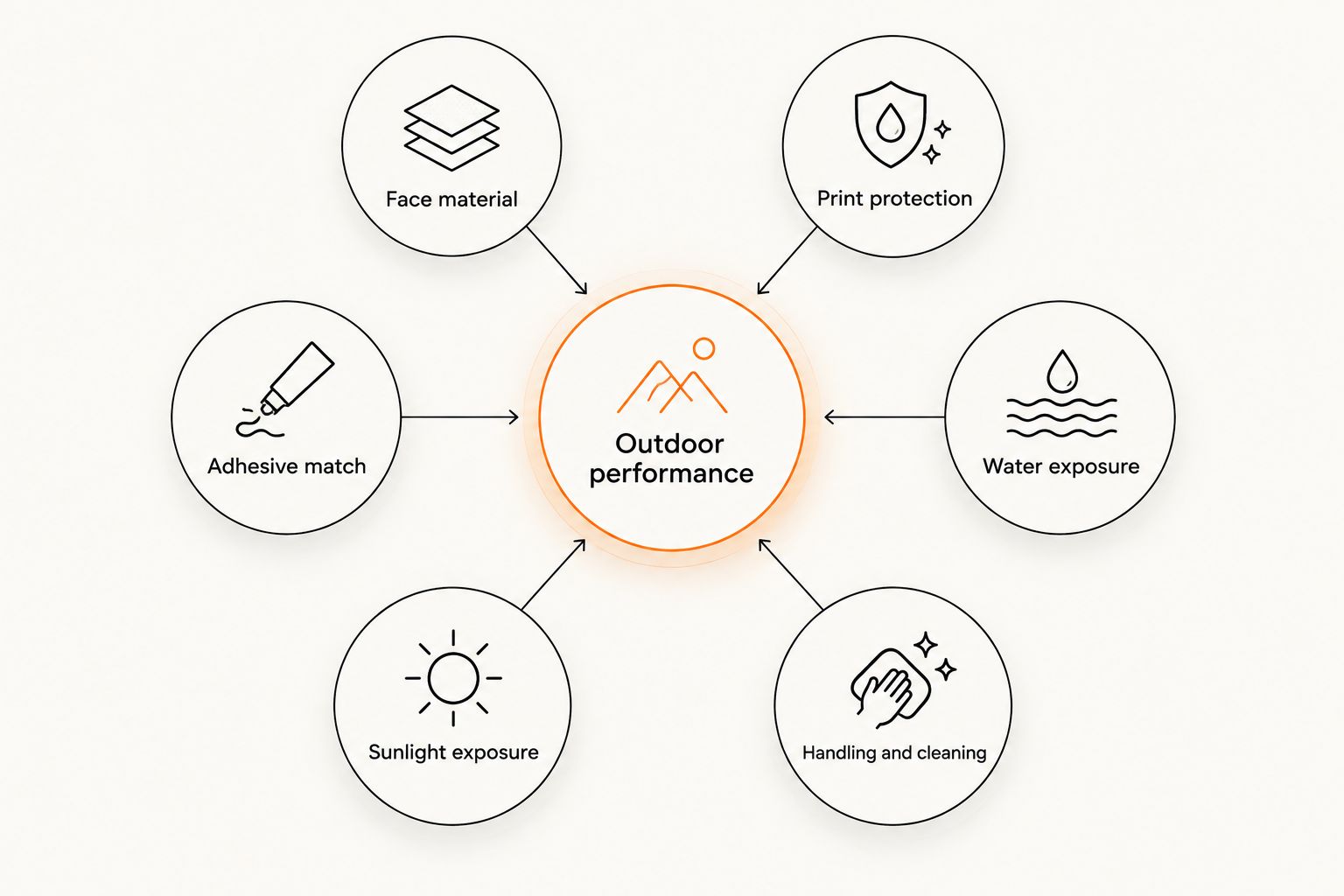
Translate each factor into a plain-language requirement. For example, describe a decal on a sun-exposed display that staff wipe during cleaning. That gives the supplier a clearer job than a request for the strongest sticker.
How should you choose stickers for an outdoor order?
Follow this sequence before committing to a bulk run. It keeps artwork decisions separate from performance checks and gives everyone approving the order the same brief.
- Define the job. State what the sticker must communicate and where it will go. Packaging identification, exterior branding and a customer-facing QR code have different readability requirements.
- Describe the surface. Name the actual object and its surface condition. Include texture, curvature and any coating rather than describing everything as plastic or metal.
- List the exposure. Explain the water, sunlight, handling and cleaning involved. Ask the supplier to confirm the selected construction against those conditions.
- Check the layout. Review the finished size, cut shape, text and margins. Print a paper mock-up at the intended size to judge placement; do not use it as a durability test.
- Approve the proof. Check the artwork and cut line carefully. Separately confirm the material and application guidance because a visual proof cannot demonstrate adhesion or weather resistance.
- Plan the quantity. Base the order on named uses, packaging demand and giveaway plans. Keep an untested application separate from a repeat order with established requirements.
For a 2026 repeat order, revisit the brief if the placement changes. Moving the same design from an indoor box to an outdoor display changes the job even when the artwork stays identical.
A correct proof and a suitable material are separate approvals. Keep both confirmations with the order so a later reorder does not rely on memory.
How do size, shape and finish affect the decision?
Measure the usable application area before choosing a size. Leave room for the sticker to sit on the intended surface rather than extending across a seam or onto an adjacent material. Check that important text remains readable at the distance customers will view it.
A die-cut outline can follow a logo, but the outline still needs to suit the application. Inspect narrow extensions and detailed edges in the proof. A simpler silhouette is easier to evaluate for placement than an intricate shape wrapped around a curved object.
Matte and glossy describe appearance, not a complete outdoor rating. Decide how you want the artwork to look, then ask separately about the construction's suitability for water, sunlight and cleaning. Do not use shine as evidence of protection.
For QR-code artwork, preserve the clear space around the code and maintain clear contrast. Scan the design at its intended size and viewing position. A successful scan on your monitor does not replace checking the actual printed application.
What should you check during proof approval?
Review the proof as an artwork decision. Confirm the correct file, spelling, orientation, cut line and placement of small details. Check the design against the object's usable area rather than approving it in isolation.
Then review the order specification as a separate decision. Confirm the requested format, material and finish, along with any documented application instructions. If the supplier offers human artwork checks, ask what those checks cover rather than assuming they include outdoor performance.
For Vinylstatus custom vinyl stickers, keep the use case explicit when asking about a format. A logo intended for a dry bag and the same logo intended for an exterior surface need different material questions, even if the proof looks identical.
Keep production and shipping separate in your schedule. Confirm when production begins, what proof approval triggers and how transit affects the required arrival date. Do not treat a production estimate as a delivery commitment.
How should you check the receiving surface?
Follow the sticker supplier's application instructions and the surface manufacturer's cleaning guidance. Start with a surface that meets those requirements. Dust, moisture and residue interfere with the intended contact between adhesive and surface.
Check the object itself. Curves, seams and texture change where the adhesive can make contact. A sticker bridging a gap is not receiving the same support as one applied flat to a suitable surface.
Do not invent a universal cleaning method. A cleaner suitable for glass is not automatically suitable for painted or coated surfaces. Confirm compatibility before cleaning or applying the sticker.
If the application is unfamiliar, ask about a suitable evaluation method before committing the full batch. A short exposure check can reveal an immediate mismatch, but it cannot establish long-term outdoor life.
Are waterproof stickers always better for packaging?
Waterproof stickers are not automatically the better packaging choice. Dry packaging and exterior labeling are different jobs. Choose the construction that satisfies the actual handling and exposure requirements.
Consider where moisture enters the process. A dry retail box does not present the same conditions as packaging handled while wet. Describe that distinction in the order brief instead of selecting by the broadest claim.
For giveaways, you do not control every application surface. Avoid promising customers that a sticker works on any object or tolerates any cleaning method. Pass along only the product guidance that applies to the ordered format.
Can you use waterproof stickers in a dishwasher?
A waterproof claim does not establish dishwasher suitability. Dishwasher use adds heat, detergent and repeated washing to water exposure. Ask for explicit guidance covering that use.
The same distinction applies to pressure washing and chemical cleaning. A sticker specified for rain is not automatically specified for every cleaning process. Treat each additional exposure as a separate requirement.
How long will an outdoor sticker last?
Outdoor sticker life depends on the specific construction and exposure. Use documented guidance for the ordered product rather than assigning a lifespan to all vinyl or waterproof stickers.
For a 2026 order, ask what conditions any stated service life assumes. Surface preparation, placement and cleaning belong in that conversation. A lifespan claim without its conditions is not a useful purchasing specification.
FAQ
What’s the main difference between waterproof vs regular stickers?
Waterproof vs regular stickers should be compared by face material, print protection, adhesive and intended exposure. Regular does not identify a specific material, and waterproof alone does not establish sunlight or cleaning resistance.
Are all vinyl stickers waterproof?
Vinyl identifies the face material, not the complete printed sticker’s water-resistance specification. Confirm the ink, protective finish, adhesive and permitted exposure for the selected format.
Are paper stickers suitable for outdoor use?
Ordinary untreated paper stickers are not a suitable substitute for stickers specified for wet outdoor exposure. Coatings and construction change performance, so check the actual product specification.
Does a glossy finish make a sticker waterproof?
A glossy appearance does not establish that a sticker is waterproof. Ask about the finished construction rather than judging water resistance from shine.
Can an online proof confirm outdoor durability?
An online proof confirms visual details, not outdoor durability. Review the artwork separately from material suitability, adhesive compatibility and application instructions.
What should I ask before ordering outdoor stickers in 2026?
For a 2026 outdoor sticker order, describe the receiving surface, water exposure, sunlight and cleaning method. Ask the supplier to confirm which selected construction meets those requirements.
Can I order custom vinyl stickers from my own logo?
Vinylstatus offers custom vinyl stickers from your own artwork. Check the intended size, cut shape and application requirements before approving the order.
One last thing
Write the application on the order brief, not just the sticker name. A note describing the surface, exposure and cleaning method is more useful than waterproof logo stickers. Keep that note with the approved artwork so your next order starts with the actual job.
Related guides