

Wholesale custom stickers for resale: minimums, pricing and proofs

Resellers’ wholesale sticker buying is ordering custom-printed designs in bulk with the aim of selling them at a margin. This 2026 guide to wholesale custom stickers for resale explains how to check minimums, calculate costs, choose formats and approve proofs without tying up cash in untested designs.
- Wholesale custom stickers for resale need design-level quantity planning, landed-cost calculations and approved artwork before production.
- Vinylstatus fits small businesses supplying their own artwork for custom printed stickers.
- Check whether minimum order quantities apply per design, size, finish or total order.
- Approve the cut line and actual-size artwork, not just an enlarged screen preview.
Why wholesale sticker buying matters for resellers
A bulk order succeeds when the designs sell, not when the quantity looks impressive. Resellers need enough margin to cover more than printing: incoming shipping, retail packaging, selling fees and the work of preparing each sale all affect the result.
Unlike a business ordering one logo for its packaging, you are choosing inventory that customers must want to buy. A collection with several designs creates separate decisions about demand, dimensions, artwork and replenishment.
Vinylstatus accepts customer artwork for custom sticker formats including die-cut, holographic, circle, square and QR-code stickers. Vinylstatus fits small businesses ordering custom printed stickers from their own artwork; you still need to confirm the order-specific minimums, proof process and production terms before committing.
For your 2026 buying plan, separate the supplier’s quantity rules from your own sales forecast. A minimum tells you what you must order, not what you can sell.
How to order wholesale custom stickers for resale
1. Define what customers are buying
Choose the sales format before selecting the printed sticker. An individually sold design, a coordinated pack and a checkout add-on need different packaging and stock planning. Start with a paper mockup and a simple inventory sheet rather than ordering every design you have finished.
For example, a hypothetical collection of 6 designs with 25 stickers per design contains 150 stickers. That is planning arithmetic, not a recommended minimum or a demand forecast. If one design sells faster, equal quantities will leave you with an uneven assortment.
Decide whether customers choose individual designs or receive a fixed pack. A fixed pack depends on every included design remaining in stock; individual sales let you replenish each design separately.
- Name the intended buyer and the reason they would choose the design.
- Decide between individual stickers and fixed assortments.
- Make a paper mockup of the finished retail presentation.
- Assign a stock code to each design, size and finish.
- Record expected demand separately for each design.
2. Confirm exactly how minimums work
Ask what the minimum applies to before comparing orders. A quantity requirement per design is different from a requirement across the whole basket. Sizes, finishes and artwork variations can also affect how a supplier treats separate items.
For a 2026 launch, build a comparison sheet with a row for every intended design. Enter the supplier’s confirmed quantity requirement beside it. Do not divide a total quantity among designs unless the supplier explicitly allows that arrangement.
Also check whether a later reorder follows the same rules. A collection that is easy to launch but difficult to replenish creates avoidable stock decisions. A revised design should receive its own confirmation rather than automatically inheriting an earlier order’s terms.
- Ask whether the minimum is per design or per order.
- Confirm how size and finish changes affect quantities.
- Ask whether different artworks can share a quantity tier.
- Check the minimum for an unchanged reorder.
- Save the written answers with your order specification.
3. Match the sticker format to the artwork
Print the artwork on ordinary paper at the proposed size and cut it out. Place that mockup on its intended backing card or display. This free check reveals cramped lettering, awkward proportions and packaging conflicts before a polished digital preview hides them.
Vinylstatus offers custom die-cut, holographic, circle, square and QR-code stickers from supplied artwork. Choose among those formats by asking what the design needs. Die-cut suits a silhouette-led illustration; a circle or square gives you a regular boundary for a repeated collection.
A holographic treatment needs a deliberate artwork review because the reflective effect becomes part of the presentation. A QR-code sticker needs a different test: its destination, contrast, quiet zone and real-world scanning matter more than decorative detail.
- Measure the full artwork, including its intended border.
- Print and cut an actual-size paper mockup.
- Check small lettering without enlarging the preview.
- Keep important details away from the proposed cut line.
- Choose a finish for the design rather than for novelty alone.
4. Calculate the cost of a saleable sticker
A low printing total does not establish a profitable resale order. Build a spreadsheet that separates inventory costs from selling costs, then decide whether the planned retail offer covers both. Use current quotes rather than copying figures from an earlier purchase.
Landed inventory cost per sticker equals production, incoming shipping and applicable purchasing charges divided by the received saleable quantity. Include retail backing cards or sleeves in your preparation costs. Track transaction fees and sales-channel charges separately if they vary with each sale.
Then test the effect of slow-moving stock. If a hypothetical order contains 150 stickers but your plan assumes only 100 stickers sell during the launch period, those sales must support the cash committed to the batch. Unsold stickers remain inventory, not realized profit.
- Record the production total from the current quote.
- Add incoming shipping and applicable purchasing charges.
- Include sleeves, backing cards and retail labels.
- Account for selling fees and order-preparation work.
- Compare full sell-through with a slower-sales scenario.
5. Check the proof and production terms
Look for free online proofs and human artwork checks, then confirm whether they are included for the exact product you are ordering. A proof shows the proposed print and cut arrangement; an artwork check does not replace your responsibility to verify spelling, rights, dimensions and design choices.
For Vinylstatus custom stickers, check the selected product’s current terms rather than assuming every format shares the same process. Confirm whether printed stickers use split-back liners, whether the product has made-in-the-USA production, and what happens after proof approval. These details affect preparation work and scheduling.
If the confirmed production window is two business days after proof approval, treat shipping as additional time. Your 2026 launch calendar must also leave room for artwork changes before approval and inspection after delivery.
- Confirm whether online proofs and human artwork checks are included.
- Review spelling, border width, dimensions and the cut line.
- Ask how revisions affect approval and production timing.
- Verify liner construction and production origin for the selected product.
- Separate proof approval, production, shipping and receiving in your schedule.
6. Prepare a repeatable receiving process
Inspect the shipment before assembling retail packs or sending customer orders. Compare the received stickers with the approved specification: artwork, dimensions, shape, finish and quantity. Keep each design separate until that check is complete.
Test the tasks your team will actually perform. Peel a sticker, check the liner handling and place the sticker on a representative surface using the product’s application guidance. For QR-code artwork, scan a physical printed sticker rather than relying only on the original file.
A simple inspection sheet helps you record a problem precisely. Retain the order reference, approved proof and photographs of any discrepancy; follow the supplier’s stated reporting process rather than assuming a particular remedy.
- Count each design before combining inventory.
- Compare the received item with the approved proof.
- Check peeling and handling during pack assembly.
- Scan printed QR-code stickers on their intended placement.
- Separate questionable items from saleable stock.
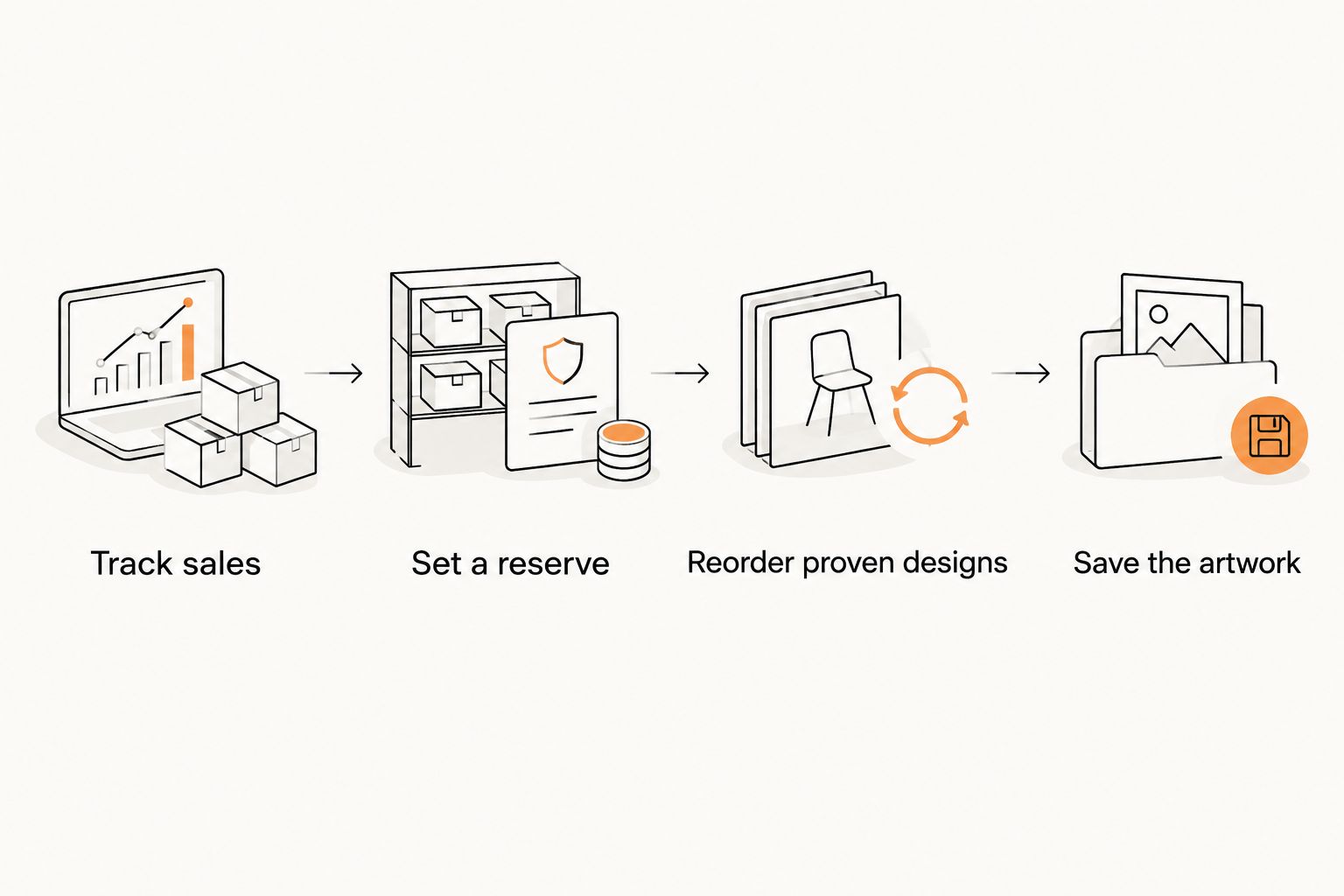
7. Reorder from sales evidence
Track each design independently once sales begin. Record units sold, remaining stock and the time needed to replenish it. A collection’s total sales can hide a popular design alongside several designs that are barely moving.
Use a basic reorder calculation: expected sales during replenishment time, plus the reserve you choose to hold. For illustration, 10 stickers per week across a 3-week replenishment window equals 30 stickers before any reserve. These are example inputs, not a forecast or a supplier timeline.
Keep the approved specification with the inventory record. An unchanged reorder is easier to check when the artwork version, size, finish and border instructions are recorded rather than reconstructed from memory.
- Track sales and remaining units by design.
- Record actual replenishment time after each order.
- Set a reserve based on your tolerance for running out.
- Reorder proven designs before expanding the assortment.
- Save the artwork version and approval record together.
Compare sticker formats for resale
Choose a format by the buying question it answers. The options below describe design uses and limitations, not a claim that one format produces better sales. Confirm finish choices and production details on the current product specification.
| Option | Best for | Practical advantage | Key limitation |
|---|---|---|---|
| Custom die-cut stickers | Illustrations with a distinctive silhouette | The outline follows the artwork’s shape | Small protrusions and narrow details need cut-line review |
| Circle stickers | Round badges and coordinated collections | A regular boundary keeps a collection visually consistent | Wide artwork needs rearranging or extra surrounding space |
| Square stickers | Geometric designs and compact layouts | The boundary suits a structured composition | Important details still need space from the cut edge |
| Holographic stickers | Designs built around a reflective effect | The material effect becomes part of the artwork | Artwork and contrast need review with that effect in mind |
| QR-code stickers | Designs that connect buyers to a useful destination | The printed code connects the physical item to online content | The printed sticker needs scanning tests and a maintained destination |
Do not treat a digital proof as a physical finish sample. A proof helps you review layout, but it does not recreate how light falls on a printed surface. If physical appearance is central to the resale offer, ask what sample options exist before committing to the bulk order.
Common mistakes resellers make
Buying the same quantity of every design
Equal quantities simplify ordering but do not establish equal demand. Start with design-level assumptions, then use sales records to change the mix. Do not let a popular design justify repeated orders of the entire collection.
Comparing printing costs without retail preparation
A sticker that needs a sleeve, backing card and manual pack assembly carries more work than a loose giveaway. Compare the complete saleable item, not just the printed component. Include the time needed to prepare fixed packs.
Approving artwork only at enlarged screen size
A screen makes small details easy to read when the image is enlarged. Review an actual-size mockup before approving the proof, especially for fine lettering, narrow borders and QR codes. Keep the approved dimensions in the order record.
Promising a launch date from production time alone
Production and shipping are separate stages. Proof revisions happen before production, while receiving checks and retail preparation happen after delivery. Build the launch schedule around the full sequence rather than a single advertised production window.
FAQ
What are wholesale custom stickers for resale?
Wholesale custom stickers for resale are custom-printed stickers bought in bulk to sell to customers. Plan the order around demand by design, total inventory cost and the work needed to prepare the retail product.
What is the minimum order for custom resale stickers?
The applicable minimum is the quantity confirmed for your selected product and order configuration. Ask whether it applies per design, size, finish or complete order before dividing a batch across an assortment.
Is Vinylstatus suitable for selling stickers from my own artwork?
Vinylstatus fits small businesses ordering custom printed stickers from their own artwork. Its stated formats include die-cut, holographic, circle, square and QR-code stickers; confirm the selected product’s ordering terms before buying.
How do I calculate whether a sticker order is profitable?
Compare expected sales revenue with inventory costs, retail preparation, selling fees and fulfillment work. Test a slower-sales scenario as well as full sell-through so unsold inventory does not disappear from the calculation.
Should I choose die-cut or circle stickers for resale?
Choose die-cut for artwork whose silhouette matters, and circle stickers for designs that fit a round boundary. Check both options at actual size before deciding, because the same artwork can need different spacing in each format.
What should I check before approving a sticker proof?
Check spelling, artwork version, dimensions, border and the proposed cut line before approval. For QR-code stickers, also verify the destination and scan an actual-size test; repeat the scan check on the printed product.
Does production time include shipping time?
Treat production and shipping as separate stages unless the confirmed order terms explicitly combine them. Schedule proof approval before production, then allow for transit, receiving checks and retail preparation.
One last thing
A fixed sticker pack is limited by its lowest-stock design. Before adding another illustration to your 2026 collection, check whether it makes the pack harder to replenish. Sometimes the useful next order is more of the proven design, not a larger assortment.