
Best custom cup and tumbler decal types for drinkware branding 2026
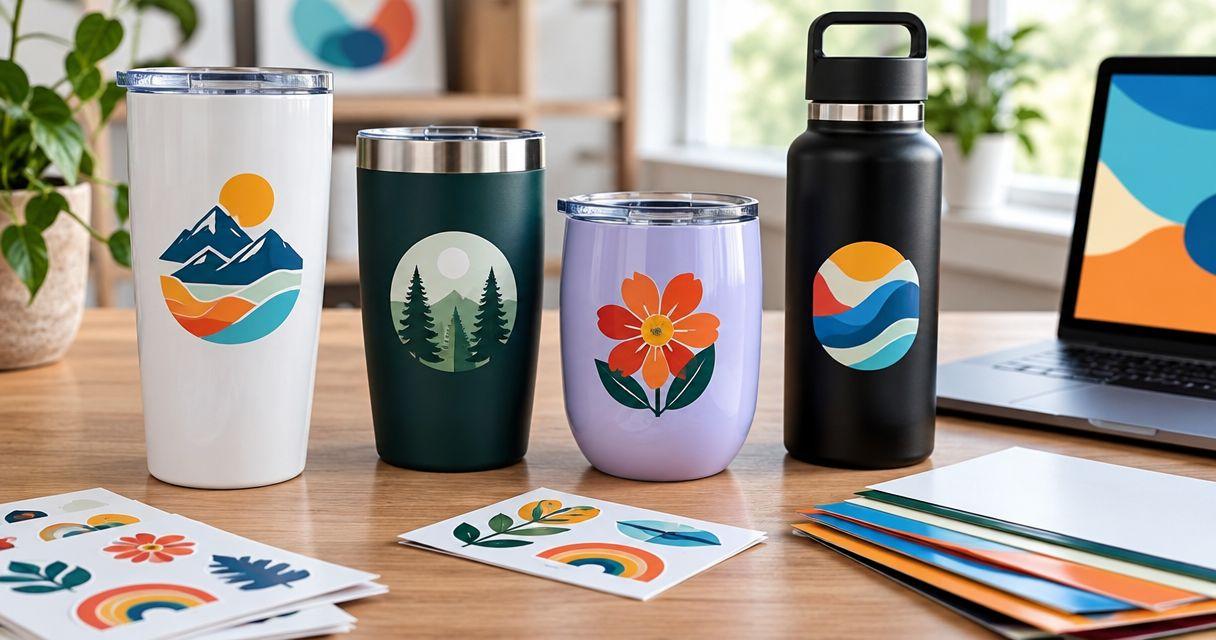
Best default for custom cup decals: die-cut stickers for a shaped logo. Best for repeat placement: circle stickers. Best for a promotional accent: holographic stickers. Vinylstatus offers these formats; choose by artwork, cup shape, and intended handling rather than appearance alone.
- Choose die-cut custom cup decals when the logo silhouette matters; test the outline on your actual drinkware.
- Circle stickers suit repeat placement; square stickers suit compact artwork but need enough uninterrupted surface.
- Holographic stickers add a reflective effect; QR-code stickers need contrast, clear margins, and a real scan test.
- Vinylstatus offers custom printed sticker formats; confirm surface compatibility and care instructions before approving a bulk order.
Why this matters
A decal that looks right on a flat proof can sit badly on a tapered tumbler. A readable logo can become difficult to recognize when its edges disappear around the cup.
For your 2026 drinkware order, separate three decisions: the printed shape, the visual finish, and the job the decal performs. Die-cut and circle describe shapes. Holographic describes an effect. A QR code describes content. These choices can overlap, so this ranking assigns each option a distinct buying purpose.
Vinylstatus custom cup decals are best suited to small businesses supplying their own artwork for printed drinkware branding. That does not establish suitability for every coating, washing method, or application surface. Confirm those details for the selected product before ordering.
What makes the best custom cup decals?
Use these criteria before choosing a format:
- Surface fit: The decal must sit within a smooth, uninterrupted area without crossing a ridge or severe change in taper.
- Artwork clarity: Your name, symbol, and essential text must remain readable at the finished size.
- Application effort: A simple outline is easier to position consistently than a complicated silhouette.
- Finish behavior: Reflective effects must support the artwork rather than obscure important details.
- Care suitability: Confirm the selected sticker's compatibility with your cup material and intended cleaning method.
- Useful quantity: Base the order on actual drinkware counts, application needs, and confirmed giveaway demand.
For sizing, use the custom logo sticker sizing guide alongside a physical mockup. A flat measurement alone does not show how much artwork disappears around a curved surface.
Custom cup decals at a glance
| Decal type | Best for | Standout feature | Key limitation |
|---|---|---|---|
| Die-cut printed sticker | Logos with a distinctive silhouette | Outline follows the artwork | Narrow extensions complicate placement |
| Circle printed sticker | Consistent placement across a cup batch | Symmetrical shape without corners | Long wordmarks need careful layout |
| Square printed sticker | Compact logos and short information panels | Straight edges organize artwork | Corners need a suitable application area |
| Holographic printed sticker | Promotional drinkware with a reflective accent | Reflective effect forms part of the design | Reflection can compete with fine details |
| QR-code printed sticker | Connecting drinkware to a specific destination | Scannable link carried on the cup | Curvature and poor contrast can prevent scanning |
These are use-case rankings, not measured durability rankings. The table does not establish dishwasher safety, adhesive strength, or compatibility with a particular tumbler coating.
1. Die-cut stickers: best custom cup decals for shaped logos
A die-cut sticker follows a custom outline around your artwork. Choose it when the outer shape helps customers recognize your logo, such as a badge, mascot, or illustrated emblem.
Keep the finished outline practical. Deep notches and thin projecting details make alignment more demanding, especially when staff apply a batch by hand.
Die-cut sticker pros:
- Preserves the recognizable silhouette of an illustrated logo.
- Removes the need to fit every design inside a standard geometric shape.
- Gives a standalone logo a defined edge against the cup.
Die-cut sticker cons:
- Complicated outlines require more care during placement.
- Tiny logo details still become tiny printed details; a shaped edge does not fix unreadable artwork.
Best for: A small business whose symbol matters more than a block of supporting text.
Order from a simplified version of your logo, not automatically from the full website header. Remove a tagline if it becomes unreadable on the mockup. Leave enough visible space around important features so the outline does not crowd them.
Verdict: Buy die-cut stickers for a recognizable silhouette; skip intricate outlines that add no branding value.
2. Circle stickers: best custom cup decals for repeat placement
A circle gives you a consistent shape without corners. It suits badge-style logos, centered illustrations, and short business names arranged around a central symbol.
The circle still needs a smooth application area. A round sticker does not automatically conform to every tapered or textured cup.
Circle sticker pros:
- Provides a symmetrical layout for repeated placement.
- Works naturally with badges and centered symbols.
- Avoids exposed square corners.
Circle sticker cons:
- Long horizontal wordmarks can look cramped.
- Increasing the diameter can push the artwork farther around the cup.
Best for: Cafés, event teams, and small businesses applying the same centered badge across a drinkware batch.
Mark the desired center position on a sample cup before production. Use a removable placement reference during application, keeping any marking away from the adhesive surface.
Verdict: Buy circle stickers for a centered badge; hold if fitting the business name requires unreadably small type.
3. Square stickers: best custom cup decals for compact information
A square provides straight edges for a compact logo, a short phrase, or a small information panel. It works when the artwork already has a square structure rather than needing to be forced into one.
Check the entire footprint on the cup. A layout that fits vertically can still extend too far around a narrow tumbler.
Square sticker pros:
- Organizes short text and a logo in a familiar layout.
- Gives square artwork a matching boundary.
- Makes horizontal and vertical alignment easy to inspect.
Square sticker cons:
- Corners need full contact with a suitable surface.
- Dense text blocks become difficult to read at small sizes.
Best for: A compact brand panel on a sufficiently broad, smooth cup surface.
Keep supporting text genuinely useful. A cup decal does not need your full address, social handles, slogan, and product list. Decide which information someone should notice while holding the drinkware.
Verdict: Buy square stickers for organized, compact artwork; skip them when the corners cross a ridge or taper transition.
4. Holographic stickers: best custom cup decals for a reflective accent
Holographic stickers make the reflective effect part of the design. Choose this option when the effect supports a promotional concept rather than simply because it looks different on a screen.
For Vinylstatus custom cup decals, confirm how the submitted artwork will interact with the selected holographic treatment. Do not assume every part of a digital preview predicts the appearance under changing light.
Holographic sticker pros:
- Adds a reflective element to the finished design.
- Gives a promotional edition a different visual treatment.
- Lets simple artwork share attention with the material effect.
Holographic sticker cons:
- Reflection can distract from fine lettering.
- A screen proof cannot reproduce every real-world lighting condition.
Best for: Promotional drinkware where a bold symbol matters more than detailed information.
Keep the main mark simple. If exact visual consistency is essential to a 2026 brand rollout, resolve questions about the reflective treatment before approving the order.
Verdict: Buy holographic stickers for an intentional reflective accent; hold when precise text readability is the main requirement.
5. QR-code stickers: best custom cup decals for a digital destination
A QR-code sticker connects the physical cup to a page such as a menu, event page, or reorder destination. Its success depends on scanning, not just looking like a recognizable code.
Keep a clear quiet zone around the code and strong contrast between the code and its background. Test the printed layout on the actual cup, because curvature changes how a phone camera sees it.
QR-code sticker pros:
- Connects the drinkware to a specific online action.
- Avoids asking customers to type a long address.
- Gives the decal a practical purpose beyond identification.
QR-code sticker cons:
- Poor contrast, distortion, or excessive curvature can prevent scanning.
- The linked destination needs to remain relevant after distribution.
Best for: A business with a clear destination and a reason for customers to scan while using the cup.
Test from ordinary holding positions, not only with the cup carefully aligned on a desk. Keep the code away from decorative elements that intrude into its clear margin.
Verdict: Buy QR-code stickers only after a successful scan test on the intended drinkware.
Check size and placement before approving artwork
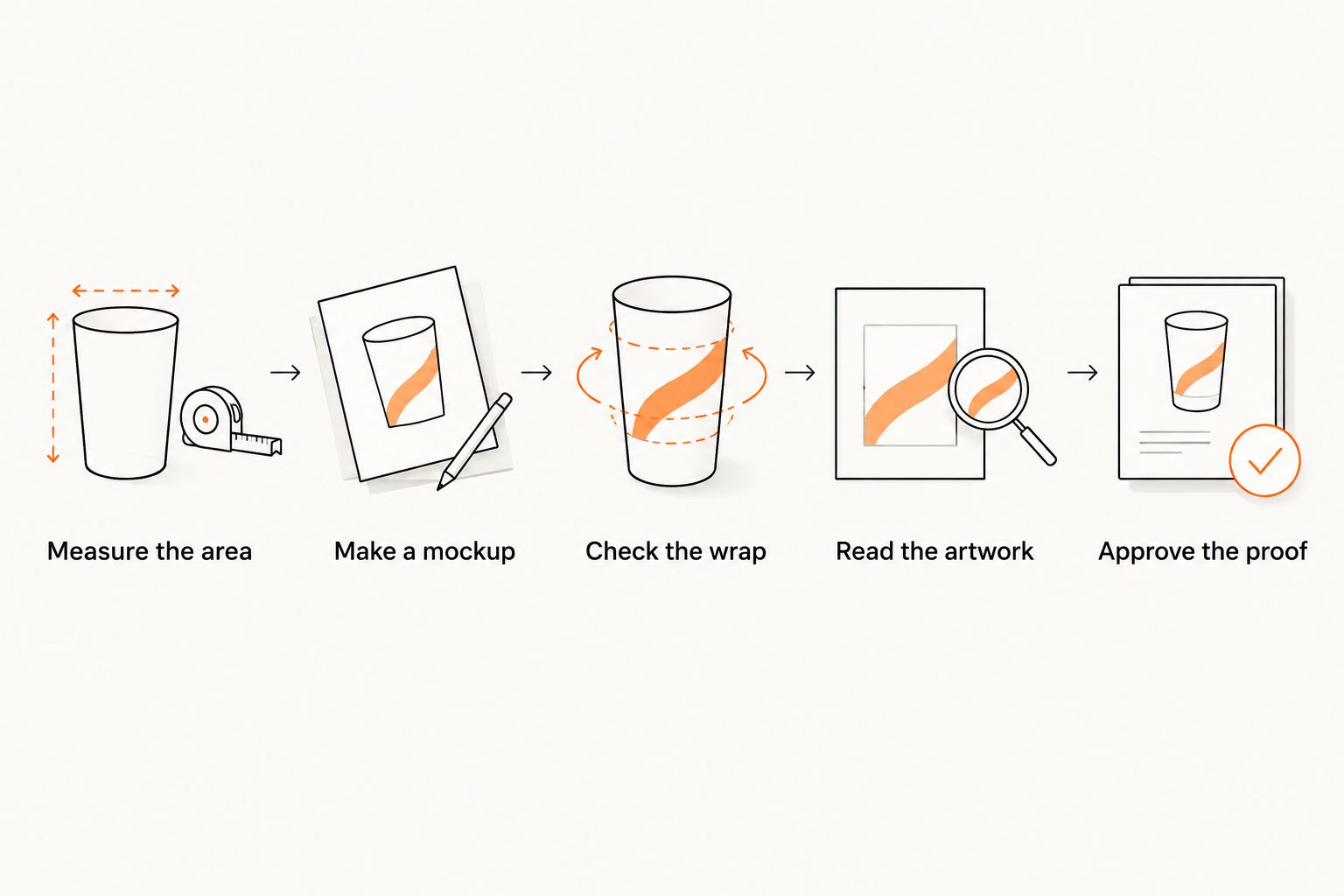
For your 2026 order, make paper mockups before committing to a finished size. Try a 2-inch-wide version and a 3-inch-wide version as comparison templates, not universal size recommendations. Wrap each around the actual cup and inspect it from the front.
Follow this sequence:
- Measure the area: Identify the smooth usable space below the rim and away from ridges.
- Make a mockup: Cut the proposed outline from paper at actual size.
- Check the wrap: Look for edges disappearing around the cup or crossing a taper transition.
- Read the artwork: Check the smallest text without enlarging it on a screen.
- Approve the proof: Confirm dimensions, outline, spelling, and placement expectations.
A proof checks the submitted design; it does not establish adhesion or washing performance on every cup. Ask which checks the printer performs and which require your own physical sample.
Plan the drinkware order and decal quantity together
Treat the cup and decal as one ordering decision. Buying drinkware before checking the usable decoration area can leave you with artwork that needs resizing or a format that does not fit.
Comparing branded ceramic mug costs belongs in the same planning exercise as decoration method, application work, and intended use. A separate decal introduces an application task; include that task when deciding whether the complete project meets your business needs.
Use a stated quantity rather than an arbitrary bulk target. For example, 100 cups plus 10 planned replacement decals equals 110 decals. This is an illustrative order plan, not a recommended spare percentage. Choose your allowance from your actual application process and intended distribution.
For a 2026 event, separate confirmed cups from optional giveaway demand. Do not treat every speculative giveaway as a committed requirement. Keep different cup sizes or artwork versions on separate order lines so quantities remain clear.
Confirm material, care, and application details
Before placing the order, send the printer the cup material, surface finish, and intended use. Glass, coated metal, and textured surfaces are different application conditions; the word “vinyl” alone does not resolve compatibility.
Ask Vinylstatus to confirm the following for the selected printed sticker:
- Whether the adhesive suits the actual cup surface.
- Which washing and care instructions apply.
- Whether a split-back liner is included for easier peeling.
- Whether online proofs and human artwork checks are included.
- Which production timing applies after proof approval, separately from shipping.
Do not translate “waterproof” into dishwasher-safe. Likewise, do not assume a decal is suitable for food contact or placement on a drinking rim. Keep decoration on the exterior, away from drinking surfaces, and follow the relevant product instructions.
Apply only to a clean, dry surface using the cleaning and application method specified for the cup and sticker. Test before committing the whole batch.
How these decal types are ranked
This 2026 guide ranks formats by artwork fit, placement, readability, and intended business use. It does not claim that one format outlasts another without product-specific evidence.
The default is die-cut for shaped logos. Circle wins the repeat-placement slot, square serves compact information, holographic serves a reflective design, and QR-code stickers serve a digital action. Change the choice when the actual cup or artwork demands it.
Which custom cup decals should you choose?
Choose die-cut stickers if your logo has a useful silhouette; choose circles if consistent badge placement matters more. Those are the clearest starting points for an undecided small-business buyer.
Before approving a Vinylstatus order, settle the cup surface, finished dimensions, readable artwork, care requirements, and useful quantity. A decorative effect is a secondary decision. A decal that does not fit or communicate clearly is the wrong order.
FAQ
What’s the best type of custom cup decal for a business logo?
Die-cut stickers suit logos with a distinctive silhouette; circle stickers suit centered badge layouts. Choose using a full-size mockup on the actual cup, then confirm the selected sticker’s surface compatibility.
Are vinyl cup decals dishwasher-safe?
Do not assume vinyl cup decals are dishwasher-safe. Follow the selected product’s care instructions and obtain confirmation for the intended washing method before ordering.
What size should I order for tumbler decals?
Order a size that fits the tumbler’s smooth usable area while keeping the artwork readable. Compare actual-size paper mockups and check whether the sides disappear around the curve.
Are circle stickers better than square stickers for cups?
Circle stickers suit centered badges without corners, while square stickers suit compact information layouts. Neither shape removes the need to check taper, texture, and full surface contact.
Can I put a QR code on a curved tumbler?
A QR code on a curved tumbler needs a real scan test at the intended size and position. Maintain strong contrast and a clear quiet zone, then test the layout on the actual drinkware.
Should I approve the artwork before checking the cup?
Check the cup before approving the artwork. Confirm the usable area, finished size, and readable details first; a digital proof does not establish adhesion or washing performance.
How many custom cup decals should a small business order?
Base the quantity on confirmed drinkware counts, separate artwork versions, and a deliberate replacement allowance. Add giveaway quantities only when they serve a defined distribution plan.
One last thing
A level-looking decal on the front of a tapered cup is not proof that its edges sit correctly. Turn the mockup all the way around and inspect both sides before approval. That final check catches placement problems a straight-on photograph hides.
Related guides
- Waterproof stickers for water bottles: a buying guide
- How to order custom stickers online: artwork to approval
- Bulk custom stickers for small businesses: an ordering guide