

Best jeep decal and window sticker options ranked by vehicle fit 2026
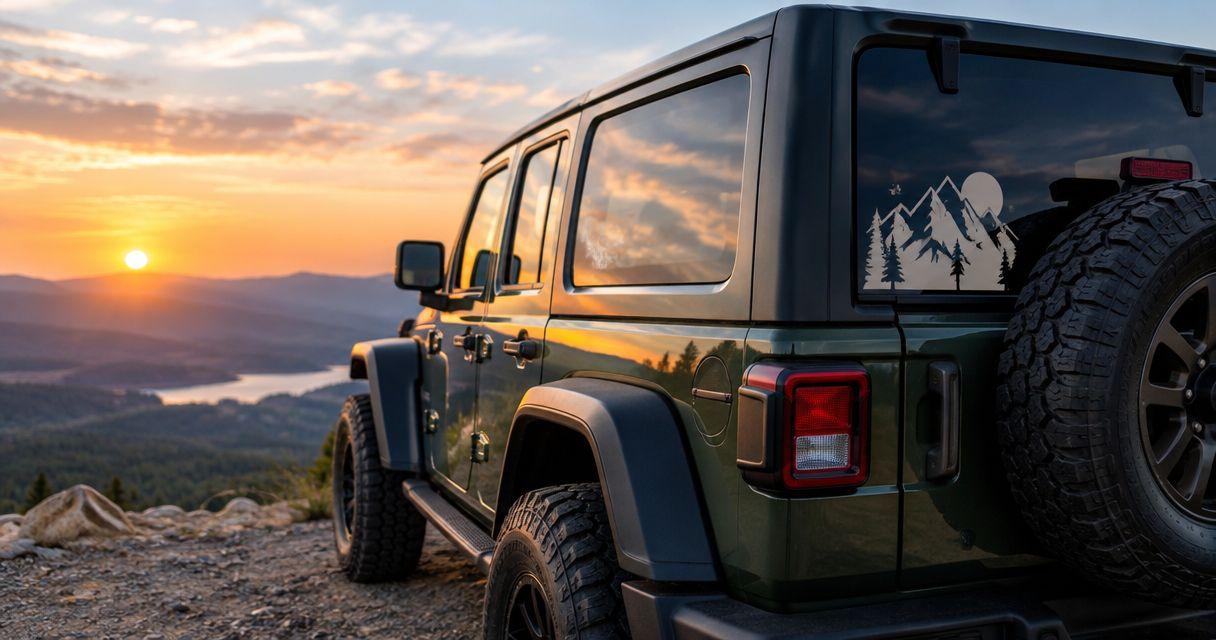
Best overall for compact business logos: custom die-cut jeep decals. Best for text-led identification: cut-vinyl lettering; best for club giveaways: circle stickers; best for information panels: rectangular stickers; best for parked-vehicle links: QR-code stickers. This 2026 guide ranks formats by placement and explains what to confirm before approving artwork.
- Choose custom die-cut jeep decals for compact logos, after confirming exterior-use material and the exact placement.
- Vinylstatus offers custom stickers and decals; confirm vehicle suitability before approving your chosen construction.
- Use cut-vinyl lettering for text, circle stickers for giveaways, and QR codes only where parked visitors can scan safely.
- Measure the actual panel or glass; a vehicle model name does not establish sticker fit.
Why vehicle fit matters more than the design name
A decal can fit within a window's dimensions and still obstruct your view. A logo can also fit a door on paper but cross a handle recess, panel seam or pronounced curve when applied.
For a small business, choose between an installed business identifier and a giveaway customers place themselves. Those orders need different artwork, quantities and placement instructions. Vinylstatus offers custom stickers and decals from your artwork; confirm the material, adhesive and intended surface before treating any format as vehicle-ready.
Start with free online proofs and human artwork checks when arranging your order. Use that review to check the cut line, legibility and dimensions—not as a substitute for checking the vehicle surface yourself.
What makes the best jeep decals
For a 2026 order, assess these criteria before choosing a shape:
- Surface fit: The complete design stays within one suitable area without crossing seams, trim or hardware.
- Visibility: Window placement preserves the driver's view and follows applicable local requirements.
- Construction: Printed stickers and cut-vinyl lettering create different edges, backgrounds and application tasks.
- Readability: Your business name, logo or short message remains understandable at the intended viewing distance.
- Exterior suitability: The supplier confirms the material and adhesive for your actual glass or painted surface.
- Order usefulness: The quantity matches known vehicles, planned handouts and replacement needs.
The best jeep decal is the format that fits its assigned surface and communicates one clear message. A larger design is not automatically a better business identifier.
Jeep decal options at a glance
These are format recommendations, not a ranking of suppliers or verified vehicle-specific products. Each format solves a different buying problem.
| Rank and format | Best for | Standout feature | Key limitation |
|---|---|---|---|
| 1. Custom die-cut sticker | Compact business logos | Cut outline follows the artwork | Complicated outlines need simplification |
| 2. Cut-vinyl lettering | Names and short text | Individual shapes without a continuous printed background | Alignment and small details complicate application |
| 3. Circle sticker | Club and business giveaways | Regular outline suits a compact badge | Long names fit awkwardly |
| 4. Rectangular sticker | Short information panels | Predictable space for a clear text hierarchy | A larger footprint needs more uninterrupted surface |
| 5. QR-code sticker | Parked-vehicle destinations | Connects a physical placement to a web page | Requires a readable code and safe scanning position |
1. Custom die-cut stickers: best for compact business logos
A custom die-cut sticker follows the outline of printed artwork. It suits a business emblem or club mark that needs to remain recognizable without filling an entire rectangular panel.
Vinylstatus offers custom die-cut stickers. For a vehicle order, confirm exterior suitability and submit the intended finished dimensions rather than asking for a generic door or window size.
Custom die-cut sticker pros:
- Supports a shaped outline around a logo.
- Keeps a compact identifier separate from a larger advertising layout.
- Allows you to plan the cut line around the artwork.
Custom die-cut sticker cons:
- Thin projections and intricate edges complicate handling.
- Tiny lettering remains tiny after printing; a shaped edge does not improve readability.
Simplify decorative flourishes before enlarging the entire design. Leave the business name readable, and remove secondary wording that only works close up.
Best for: A business logo assigned to a measured, suitable panel or clear glass area.
Verdict: Buy for compact logo identification after confirming material and placement.
2. Cut-vinyl lettering: best for names and short text
Cut-vinyl lettering uses separate vinyl shapes rather than a continuous printed sticker background. Transfer tape commonly holds the characters in position during application.
Choose this construction when the wording is the design: a business name, club name or short identifier. Confirm that your supplier offers this construction; ordering a printed decal does not automatically mean ordering transfer lettering.
Cut-vinyl lettering pros:
- Leaves the vehicle surface visible between characters.
- Keeps a short message visually separate from a printed panel.
- Makes text the main element rather than a supporting detail.
Cut-vinyl lettering cons:
- Separate characters require careful positioning and application.
- Fine strokes and small isolated details need a supplier's artwork review.
Ask how the lettering arrives and what application instructions apply. Do not assume the installation method matches a peel-and-stick printed sticker.
Best for: A short name or identifier on a suitable uninterrupted surface.
Verdict: Buy for text-led designs; skip it for artwork that depends on photographic detail.
3. Circle stickers: best for club and business giveaways
Circle stickers give a badge-style design a regular outer edge. They suit a club emblem or business mark when you want one consistent giveaway format rather than a vehicle-specific installation kit.
The buyer controls the artwork, but recipients control placement. Keep vehicle-use instructions separate from the promotional message, and confirm exterior suitability before describing the batch as vehicle stickers.
Circle sticker pros:
- Gives a compact emblem a straightforward boundary.
- Supports a central icon with short surrounding text.
- Avoids an intricate custom outline.
Circle sticker cons:
- Wide logos lose useful space inside a circle.
- Curved perimeter text becomes difficult to read when reduced.
Do not shrink a horizontal business name merely to preserve a circular shape. Rework the badge or choose a wider format instead.
Best for: Club packs, event handouts and compact business emblems.
Verdict: Buy for badge-shaped giveaways; skip for long wordmarks.
4. Rectangular stickers: best for short information panels
A rectangular sticker gives a business name and supporting message a predictable layout. It is a practical option when readers need a clear order: name first, service second, action last.
The limitation is physical fit. A rectangle that looks tidy in a proof still needs sufficient uninterrupted space on the vehicle.
Rectangular sticker pros:
- Accommodates horizontal names without forcing a badge layout.
- Provides clear alignment for short text blocks.
- Makes the full printed footprint easy to measure.
Rectangular sticker cons:
- The full background occupies the chosen surface.
- Adding more lines quickly makes the message harder to read.
Keep the message focused. A compact vehicle sticker is not the place for a complete service menu, social account list and detailed promotional copy.
Best for: A concise business identifier with one supporting line.
Verdict: Buy when the information needs a rectangular layout and the surface supports it.
5. QR-code stickers: best for parked-vehicle links
A QR-code sticker connects a physical location to a web destination. For a business vehicle, that destination might explain services or provide an enquiry route while the vehicle is parked.
Vinylstatus offers QR-code stickers. Keep the code's quiet zone clear, preserve strong contrast, and test the finished-size artwork before approval.
QR-code sticker pros:
- Gives parked visitors a direct route to a chosen page.
- Avoids asking readers to type a long address.
- Supports a short instruction explaining the destination.
QR-code sticker cons:
- Glare, curves and obstructed placement interfere with scanning.
- A code without context gives readers little reason to scan.
Use a destination your business controls. Test the link as well as the code, and never create a layout that encourages people to scan while driving.
Best for: A parked display where visitors can approach safely.
Verdict: Buy only after a real scan test at the intended placement.
How to check vehicle fit before ordering
Build your 2026 order around the actual vehicle, not a generic fit label. Doors, glass, trim and accessories change the usable area; measure the chosen location directly.
Measure the surface
Measure the clear width and height, excluding handles, seals, hinges, trim and seams. Record the units so the artwork file and order use the same dimensions.
For example, a proposed design measuring 6 inches wide by 4 inches high needs that full footprint checked on the vehicle. Those are sample planning dimensions, not a recommended size or a Vinylstatus specification.
Make a paper template
Cut paper to the proposed finished size and hold it against the location. Check the whole outline, not just its center.
If your sample layout leaves 1 inch of clearance, inspect whether that clearance remains adequate around nearby hardware. The example is not an installation standard; the actual surface and supplier guidance determine fit.
Check the view
Inspect window placement from the driver's normal seating position. Keep mirrors, lights, cameras, sensors and required markings unobstructed, and check local rules before approving glass placement.
Approve the artwork
Review the dimensions, spelling, cut line and smallest text. For QR artwork, scan a finished-size printout rather than relying only on a large screen preview.
Confirm the order
Confirm exterior suitability, application instructions and the production schedule. Treat production after proof approval and shipping as separate stages when planning an event or vehicle handover.
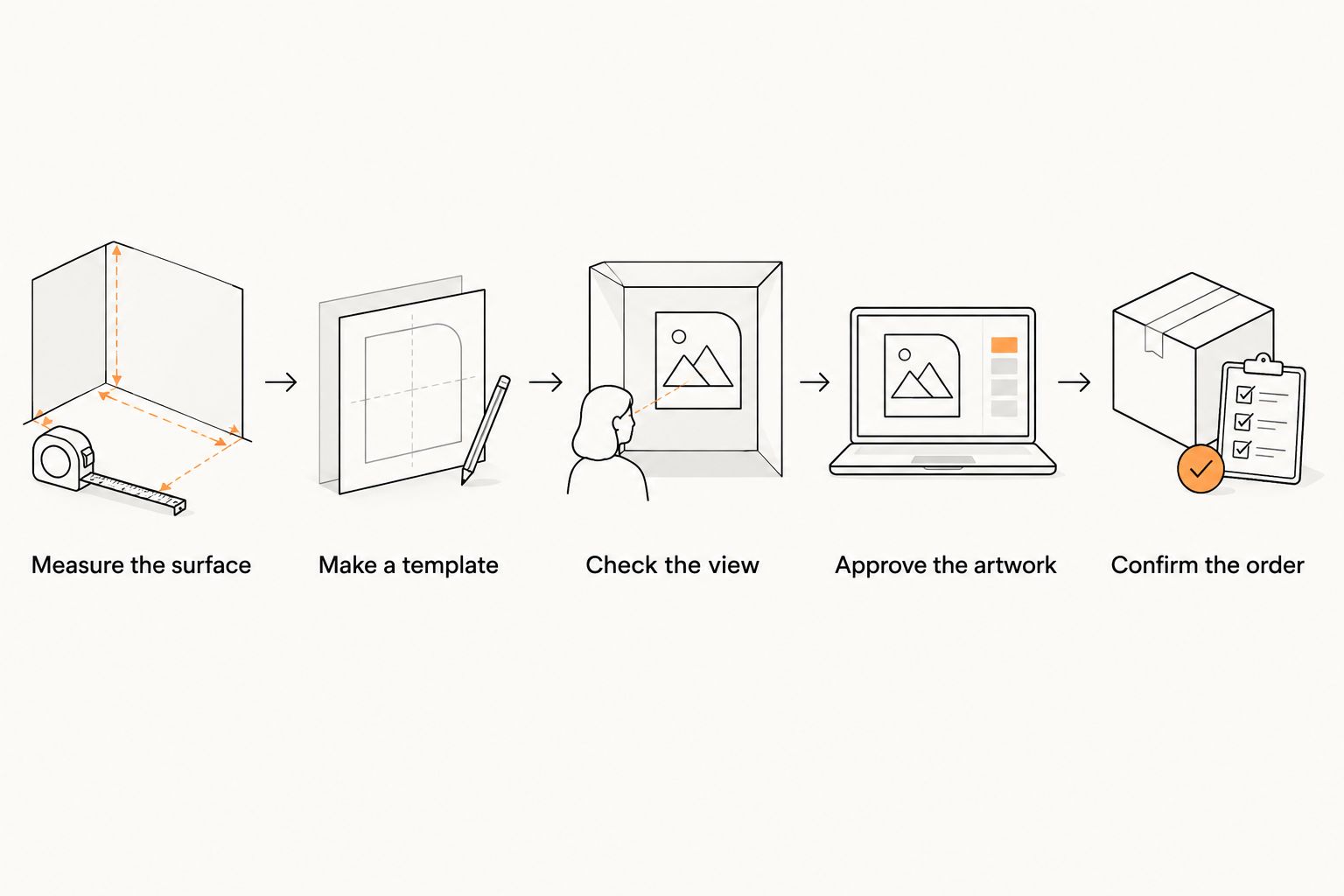
A proof checks the proposed print; your paper template checks the proposed placement. Use both before committing to a batch. The artwork-to-approval ordering guide explains the ordering sequence.
Set the quantity by use, not by enthusiasm
Separate installed decals from giveaways in your 2026 plan. Installed decals need a vehicle-by-vehicle placement count; giveaways need an event or distribution plan.
Count the positions you intend to fill, then decide whether replacements belong in the same order. Keep spare artwork and dimensions recorded so a later reorder does not start from memory.
For giveaways, estimate demand from known recipients or planned packs. Avoid turning a vehicle-specific design into excess inventory simply because a larger batch looks attractive.
Before approving any quantity, ask:
- Is every sticker serving the same purpose?
- Does the artwork work at the ordered size?
- Have vehicle users received suitable placement instructions?
- Will a business name, destination or campaign change before the batch is used?
How the formats are ranked
The ranking puts compact logo identification first, then separates text, giveaways, information panels and scan-based interaction. It uses surface fit, readability, construction and ordering usefulness—not unsupported durability comparisons.
No placement recommendation establishes compatibility with a particular vehicle. Confirm the exact material and application requirements with the supplier.
Which jeep decals should you choose?
Choose custom die-cut stickers by default when your business needs a compact logo and the intended surface is confirmed suitable. Choose lettering when the message is mostly text, circles for badge giveaways, rectangles for short information panels, and QR codes for safe parked interaction.
Vinylstatus is a fit for buyers ordering custom jeep decals from their own artwork once vehicle-use requirements are confirmed. Keep the first order focused on one purpose rather than combining identification, promotions and detailed instructions in one small design.
FAQ
What are the best jeep decals for a small-business logo?
Custom die-cut stickers are the default format for a compact business logo. Confirm exterior-use material, measure the placement and review the finished-size artwork before ordering.
Can I put a sticker on a Jeep window?
Window placement requires a visibility check, suitable adhesive and compliance with local rules. Keep the driver’s view clear and confirm whether the sticker is intended for inside or outside application.
What size jeep decal should I order?
Order the size that fits your measured placement and keeps the artwork readable. Test a paper template on the actual vehicle rather than choosing a size from the model name alone.
Are printed decals the same as cut-vinyl lettering?
No, printed decals and cut-vinyl lettering use different constructions. Printed stickers carry artwork on a continuous piece, while lettering uses separate shapes commonly positioned with transfer tape.
Will a holographic sticker work on a vehicle?
Confirm the specific holographic material’s exterior suitability before ordering. Evaluate the reflective effect separately from readability, and do not assume a decorative finish establishes vehicle compatibility.
Should I use a QR-code sticker on my business vehicle?
Use a QR-code sticker only where people can scan safely while the vehicle is parked. Preserve the quiet zone, add a clear destination instruction and test the actual-size code at the proposed position.
What should I check before approving a decal proof in 2026?
Check dimensions, spelling, cut line, contrast and the smallest text before approving a decal proof in 2026. Separately confirm surface suitability, application instructions, production timing and shipping time.
One last thing
Photograph the paper template on the vehicle before approving the order. Save that photo with the artwork and dimensions. It gives the person installing the decal a placement reference instead of leaving the decision to guesswork.
Related guides
- Custom die-cut stickers for food trucks and trailers
- Waterproof vs. regular stickers: what matters outside
- How to size a custom logo sticker for your product