

Best motorcycle decal and tank sticker options for riders 2026

Best for shaped logos: die-cut stickers. Best for club badges: circle stickers. Best for reflective artwork: holographic stickers. Choose custom motorcycle decals by artwork and placement—not appearance alone—and confirm paint compatibility before applying any sticker to a tank. Vinylstatus prints custom sticker formats from your artwork; this 2026 guide explains which formats fit rider giveaways, shop branding and proposed motorcycle placements.
- Choose die-cut custom motorcycle decals for shaped logos; confirm tank-surface compatibility before ordering.
- Circle stickers suit club badges; square stickers give workshop graphics a defined border.
- Holographic stickers add a reflective effect, not proof of fuel resistance or paint compatibility.
- Vinylstatus offers custom sticker formats; approve artwork separately from confirming motorcycle-surface suitability.
Why this matters
A motorcycle shop needs different stickers for different jobs. A logo handed out with a service receipt does not have the same requirements as artwork applied beside a fuel filler.
A printed sticker is not automatically a tank protector, fuel-resistant decal or paint-safe removable graphic. Confirm those properties separately. Shape, finish and an attractive proof cannot establish them.
For a 2026 club event or shop campaign, separate the order into its actual uses: packaging, giveaways and vehicle application. That distinction prevents a good promotional sticker from being ordered for an unverified surface.
What makes the best custom motorcycle decals?
Judge the format against these criteria before choosing a design:
- Surface suitability: Identify the exact painted panel, plastic part or packaging surface. Ask whether the sticker construction suits it.
- Artwork fit: Match the cut shape to the logo. Keep fine lettering and narrow projections under review.
- Placement fit: Measure the usable area, including curves, seams and clearance around working parts.
- Finish control: Choose a plain or reflective appearance deliberately. Check how the background affects the artwork.
- Proof clarity: Review dimensions, cut lines, borders and lettering before approval. A proof checks artwork, not adhesion.
- Useful quantity: Count confirmed uses and recipients. Keep date-specific event artwork separate from an evergreen shop logo.
Motorcycle sticker formats at a glance
These are format recommendations, not a ranking of tested automotive materials. No format below establishes tank suitability by itself.
| Format | Best for | Standout feature | Key limitation |
|---|---|---|---|
| Die-cut sticker | Shaped shop or rider logos | Cut outline follows the artwork | Intricate outlines need careful proof review |
| Circle sticker | Club badges and event emblems | Consistent round boundary | Wide logos need rearranging or extra space |
| Square sticker | Workshop graphics and merchandise packaging | Defined corners and straight edges | Corners need attention near curved placements |
| Holographic sticker | Artwork built around a reflective effect | Background contributes to the design | Reflective areas can compete with small details |
| QR-code sticker | Service, booking or club-information links | Connects a printed graphic to a destination | Requires scan testing and destination maintenance |
1. Die-cut stickers: best for shaped motorcycle logos
Die-cut stickers follow the artwork's outline instead of placing every design inside a circle or square. They suit a motorcycle shop wordmark, a riding-club illustration or an emblem with a recognizable silhouette.
For motorcycle decals, use a clear outer contour. Ask the artwork checker to review narrow tips, tiny isolated details and tight internal gaps rather than assuming every drawn feature should become part of the cut edge.
Die-cut sticker pros:
- Preserves a distinctive logo silhouette.
- Avoids unnecessary rectangular space around irregular artwork.
- Gives shop merchandise and giveaways a consistent logo shape.
Die-cut sticker cons:
- Complex outlines require more attention during proof approval.
- A shaped edge does not establish suitability for a curved tank.
Best for: Shops and clubs whose logos depend on their outline.
For a tank placement, make a paper template of the complete outer shape. A narrow logo can still cross an awkward curve if its ends extend beyond the usable panel.
Verdict: Buy for shaped-logo giveaways; hold tank application until surface suitability is confirmed.
2. Circle stickers: best for motorcycle club badges
Circle stickers give club initials, emblems and event graphics a fixed boundary. They work especially well when the artwork already has a round composition, with the main symbol centered and supporting text around it.
Do not shrink a wide wordmark simply to force it into a circle. Rearrange the artwork or choose a different format if the lettering becomes difficult to read.
Circle sticker pros:
- Matches round badge artwork without an elaborate cut path.
- Keeps club merchandise visually consistent.
- Has no corners to position around nearby panel features.
Circle sticker cons:
- Leaves unused space around long horizontal logos.
- Curved lettering needs checking at the final printed size.
Best for: Club insignia, ride-event emblems and circular shop badges.
For a 2026 ride, decide whether the date belongs on every sticker. An undated club badge can serve ongoing membership uses; a dated graphic belongs to that specific event.
Verdict: Buy for round badge artwork; skip the circle if fitting it makes the logo unreadable.
3. Square stickers: best for workshop and merchandise graphics
Square stickers provide a defined frame for stacked lettering, an illustrated mark or a shop graphic. They also suit flat merchandise packaging where straight edges help establish placement.
A square is not a shortcut around tank geometry. Check all corners on the intended location, not just the center of the sticker.
Square sticker pros:
- Gives stacked text a clear boundary.
- Accommodates layouts with a symbol above a business name.
- Makes alignment on flat packaging straightforward.
Square sticker cons:
- Corners need particular attention near changing surface curves.
- A square border adds visible background around irregular artwork.
Best for: Workshop branding on merchandise packaging and other confirmed flat surfaces.
If your main use is boxes or giveaway inserts, design for that job first. Do not compromise a useful packaging sticker to accommodate an unconfirmed motorcycle placement.
Verdict: Buy for framed workshop graphics; hold curved-panel use until the full footprint is checked.
4. Holographic stickers: best for reflective rider artwork
Holographic stickers use a reflective visual effect as part of the design. Choose this format when the changing background supports the illustration—not merely because a finish sounds more specialized.
Plan which areas should show the effect and which details need a controlled background. Ask how the proposed printing treatment will reproduce your artwork before approving it.
Holographic sticker pros:
- Adds a reflective element to rider illustrations.
- Creates a distinct version of an existing shop graphic.
- Gives merchandise artwork another visual treatment without changing its outline concept.
Holographic sticker cons:
- Small lettering needs careful contrast review.
- The finish alone says nothing about fuel exposure or outdoor service life.
Best for: Bold illustrations designed around the reflective background.
For a 2026 merchandise release, review the holographic version separately from the plain version. Artwork that reads clearly against a solid background needs another check when the background contributes its own visual effect.
Verdict: Buy for intentional reflective artwork; skip it when small text is the design's main job.
5. QR-code stickers: best for service and club-information links
QR-code stickers connect printed artwork to a booking page, maintenance information or club details. Put them where people can stop, read the surrounding instruction and scan safely.
A counter display, merchandise insert or suitable stationary surface is a clearer starting point than a moving motorcycle. Confirm surface compatibility wherever the sticker will actually be applied.
QR-code sticker pros:
- Connects a printed graphic to detailed information.
- Keeps lengthy instructions outside the sticker layout.
- Gives shops and clubs a specific action to request.
QR-code sticker cons:
- Requires a working destination that someone maintains.
- Needs a clear quiet zone, adequate contrast and a real scan test.
Best for: Shop booking information and stationary club-information displays.
Test the code at the final intended size, not only enlarged on a screen. Check the destination on a phone before approving the artwork.
Verdict: Buy for a defined scan action; skip placements where safe scanning is impractical.
How these formats were ranked
The order follows buying questions: preserve a logo outline, frame a club badge, organize a workshop graphic, add a reflective effect or provide a scannable action. No laboratory durability comparison or motorcycle-paint compatibility test is claimed.
Vinylstatus is a custom motorcycle decals option for shops and clubs supplying their own artwork. Choose the format by its job, then confirm the material requirements for the proposed application.
Check tank placement before ordering
Start with the actual panel, not a photograph of a similar motorcycle. A flat-looking area can change shape near its edges.
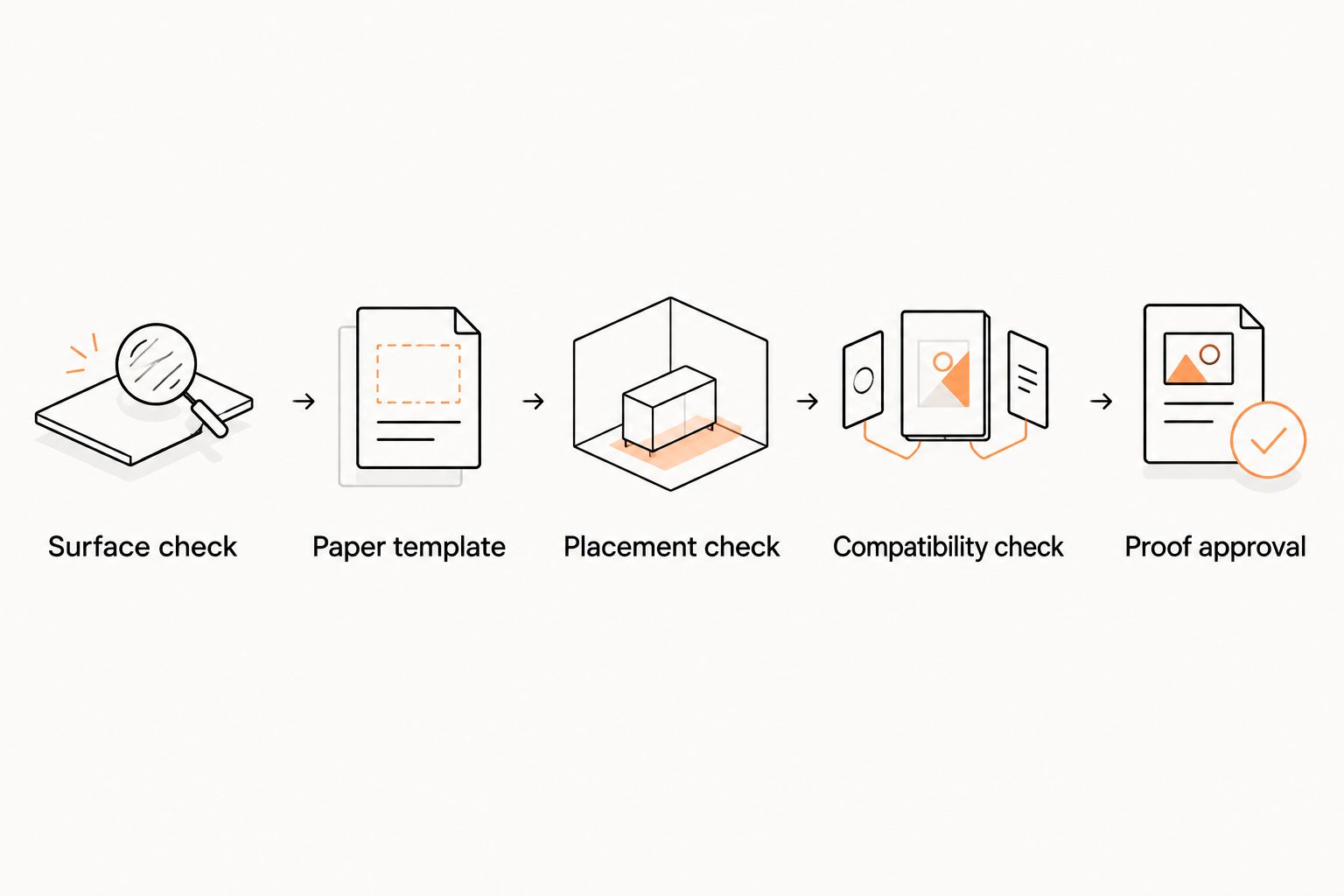
Use this sequence before approving tank artwork:
- Surface check: Record the surface material and finish. Identify repainting, coatings or other treatments that the supplier needs to know about.
- Paper template: Print the outline at its intended size. For example, compare a 3-inch-wide template with a 4-inch-wide template; these are layout trials, not recommended tank sizes.
- Placement check: Hold the template against the panel. Check curves, seams, filler access, warning labels and contact with riding gear.
- Compatibility check: Ask about the exact application, cleaning method, expected exposure and removal requirements.
- Proof approval: Approve the artwork only after the size and intended use are settled.
Do not treat a decorative sticker as protection against fuel spills, scratches or repeated rubbing. If protection is the job, request documentation for that job rather than choosing by appearance.
For helmet placement, consult the helmet manufacturer's instructions separately. Permission for one painted surface does not establish compatibility with another item.
Build a useful bulk order
Vinylstatus's ordering guidance emphasizes free online proofs and human artwork checks. Use those checks to resolve the cut outline, border, text and layout; they do not replace confirmation of the intended application.
The stated production timing is two business days after proof approval, with shipping time additional. Confirm that timing for your selected order before setting an event deadline, and ask whether the printed stickers include split-back liners for easier peeling.
For a hypothetical order, 80 event packs with 1 sticker each require 80 stickers. Add extras only for identified uses, such as staff packs or a merchandise table. Keep that calculation separate from any unverified vehicle-placement demand.
Before submitting your 2026 order, prepare:
- The artwork and intended cut shape.
- Final dimensions, with units clearly stated.
- The finish and areas where background effects should appear.
- Quantities separated by design and use.
- Questions about surface compatibility and application.
- The date you need the finished order, including shipping time.
Follow the artwork-to-approval ordering guide when preparing the file. Approve the actual dimensions and cut line, not just the overall impression.
Which motorcycle sticker format should you choose?
Choose die-cut for an outline-led logo and circle for a round club badge. Choose square for framed workshop graphics, holographic for artwork built around reflection and QR-code stickers for a specific scan action.
For tank stickers, stop before approval if surface compatibility remains unresolved. The default recommendation is a clear logo, a measured paper template and confirmed application requirements—not a decorative finish selected first.
FAQ
What’s the best format for custom motorcycle decals?
Die-cut stickers suit shaped logos, while circle stickers suit round club badges. Choose by artwork and placement, then confirm material suitability for any motorcycle application.
Can I put a custom sticker on my motorcycle tank?
Confirm compatibility with the exact tank finish before applying a sticker. Ask about coatings, fuel exposure, cleaning and removal; a print proof does not answer those questions.
Are holographic motorcycle stickers fuel-resistant?
A holographic appearance does not establish fuel resistance. Request documentation for the actual sticker construction and intended exposure before using it near a fuel filler.
What size should a motorcycle tank sticker be?
Choose the size from the usable panel area and the logo’s readability. Hold a full-size paper template against the tank and check every edge before ordering.
Should I choose circle or die-cut club stickers?
Choose circle stickers for round badge artwork and die-cut stickers when the logo’s outline matters. Check small lettering at the final size in either format.
Does proof approval confirm that a sticker is safe for paint?
No, proof approval confirms the artwork you authorize for printing. Paint compatibility requires a separate answer about the surface, adhesive, exposure and removal method.
How should a motorcycle shop plan a bulk sticker order in 2026?
Count confirmed packaging, event-pack and giveaway uses separately. Choose quantities by design, resolve artwork questions before approval and allow for shipping in addition to production.
One last thing
Approve the placement before the print. A perfect logo file cannot fix a sticker that crosses an unsuitable curve or covers information you need to read.
Keep the paper template with your order notes. Record the chosen dimensions, surface and placement so the next order starts with a documented decision rather than another guess.
Related guides
- How to size a custom logo sticker
- Waterproof vs. regular stickers: what matters outside
- Do holographic stickers fade outdoors?